Responsive Angular 20+ Dashboards: Mobile Drawers and Tactile Micro‑Interactions Recruiters Can Inspect
A practical UX systems playbook for enterprise dashboards—measurable polish, mobile-first drawers, and micro‑interactions that don’t break performance budgets.
If it jitters, it’s broken. Tactile, accessible, and measurable beats flashy every time.Back to all posts
The moment that changed my approach to mobile dashboards: a recruiter opened our KPI view on a mid‑range Android, flicked the drawer, and watched it jitter. In a room full of stakeholders, tiny UX decisions were suddenly the whole conversation. Since then—at a global entertainment company (employee tracking), Charter (ads analytics), and an insurance technology company (telematics)—I’ve treated drawers, density, and micro‑interactions as first‑class engineering problems with budgets, telemetry, and tests.
As companies plan 2025 Angular roadmaps, here’s how I build responsive Angular 20+ dashboards with Signals/SignalStore, PrimeNG, and Nx—tactile, accessible, and fast—so recruiters and directors can inspect the polish without a lab setup.
Why Responsive Dashboards and Tactile UX Matter in Angular 20+
Executive stakes
When your dashboard jitters or your drawer steals focus, leaders assume the underlying numbers aren’t dependable. On Charter’s ads analytics portal, fixing minor scroll/hover inconsistencies increased daily active usage by 11% with zero new features.
Mobile first impressions drive hiring decisions.
Micro‑jank erodes trust in analytics accuracy.
Engineering stakes
Angular 20+ gives us Signals, SSR hydration improvements, and fine‑grained change detection. Use them to isolate animation and layout state so interactions feel immediate without blowing LCP/CLS.
Core Web Vitals are the floor; tactility is the differentiator.
Signals replace brittle zone.js patterns for layout state.
Build Responsive Grids, Role‑Based Views, and Virtualization
<!-- Responsive grid with PrimeNG + CSS Grid -->
<section class="grid" role="region" aria-label="KPI grid">
  <div class="card" *ngFor="let w of widgets()">
    <app-kpi [data]="w"></app-kpi>
  </div>
</section>
.grid {
display: grid;
grid-template-columns: repeat(
auto-fill,
minmax(clamp(240px, 30vw, 420px), 1fr)
);
gap: var(--space-3);
}
.card { min-height: 180px; }Grid + cards that scale down cleanly
On a broadcast media network’s VPS scheduler, responsive cards kept critical info above the fold on phones while preserving dense calendar context on desktop.
Use CSS Grid with clamp() for columns and gutters.
Prefer skeletons over spinners for perceived speed.
Role‑based dashboards
Multi‑tenant and role‑based views (e.g., an insurance technology company telematics: Driver vs. Fleet Manager) require predictable layout changes. Compute visible widgets via Signals to avoid spikes in change detection.
Gate data with server‑side policies; mirror in UI selectors.
Precompute visibility with Signals to reduce DOM thrash.
Virtualize heavy lists/tables
an enterprise IoT hardware company’s device portal went from 800ms scroll stutters to smooth 60fps by virtualizing table sections and deferring chart sparkline rendering until rows entered view.
Use CDK Virtual Scroll for 1k+ rows.
Defer cell renderers until in viewport.
Avoid layout shift with fixed row heights.
Mobile Drawers that Feel Native and Stay Accessible
// layout.store.ts — SignalStore for layout & drawer
import { signal, computed, effect, Injectable } from '@angular/core';
import { signalStore, withState, patchState, withMethods } from '@ngrx/signals';

interface LayoutState {
  drawerOpen: boolean;
  density: 'comfortable' | 'compact';
  theme: 'light' | 'dark';
  width: number; // window width for responsive logic
}

const initial: LayoutState = { drawerOpen: false, density: 'comfortable', theme: 'light', width: 1280 };

export const LayoutStore = signalStore(
  withState<LayoutState>(initial),
  withMethods((store) => ({
    setWidth: (w: number) => patchState(store, { width: w }),
    toggleDrawer: () => patchState(store, { drawerOpen: !store.drawerOpen }),
    setDensity: (d: LayoutState['density']) => patchState(store, { density: d }),
    setTheme: (t: LayoutState['theme']) => patchState(store, { theme: t })
  }))
);

@Injectable({ providedIn: 'root' })
export class LayoutFacade {
  private s = new LayoutStore();
  isMobile = computed(() => this.s.width < 960);
  drawerOpen = computed(() => this.s.drawerOpen && this.isMobile());
  density = computed(() => this.s.density);
  theme = computed(() => this.s.theme);

  constructor() {
    effect(() => {
      localStorage.setItem('density', this.density());
      localStorage.setItem('theme', this.theme());
    });
  }
}
<!-- PrimeNG Sidebar as mobile drawer -->
<p-sidebar
[(visible)]="layout.drawerOpen()"
[blockScroll]="true"
[modal]="true"
role="dialog"
aria-label="Navigation drawer"
(onHide)="returnFocusToTrigger()"
>
<nav>
<a pRipple routerLink="/home">Home</a>
<a pRipple routerLink="/reports">Reports</a>
</nav>
</p-sidebar>
<button pButton type="button" (click)="layout.toggleDrawer()" aria-controls="nav-drawer">Menu</button>/* Motion curve + reduced motion */
:root { --easing-snappy: cubic-bezier(.2,.8,.2,1); --anim-quick: 260ms; }
.p-sidebar { transition: transform var(--anim-quick) var(--easing-snappy); }
@media (prefers-reduced-motion: reduce) {
.p-sidebar { transition: none; }
}Signals-driven layout state
Signals make drawer state deterministic across SSR/CSR. Persist user choices (density, theme) without triggering app‑wide change detection.
No global services with mutable flags.
Computed breakpoints for desktop vs mobile.
Focus, ARIA, and keyboard
Recruiters test this. If Esc or Shift+Tab escapes the drawer improperly, it reads as sloppy engineering.
Focus trap within drawer; return focus on close.
ARIA labels and role="dialog" for Sidebar.
Gesture physics and reduced motion
at a major airline’s kiosks, we tuned swipe velocities to avoid accidental triggers during turbulence—responsive, but predictable.
Use cubic‑bezier curves tuned to 240–320ms.
Disable velocity‑based gestures when prefers-reduced-motion is set.
Tactile Micro‑Interactions Without Jank
Make it feel touchable
Small affordances—shadow, scale, ripple opacity—signal interactivity. In a cloud accounting platform dashboards, we dropped ripple alpha by 20% to reduce visual noise on dense grids.
Elevations step 1→2 on hover/touch.
Harmonize ripple with brand palette and AA.
Loaders and skeletons
For an insurance technology company telematics, skeleton cards synchronized with WebSocket connection state to avoid popping KPI layouts during reconnects.
Skeletons at steady 60% brightness.
Reserve space to avoid CLS.
Design Tokens: Typography, Density, and the AngularUX Color Palette
/* tokens.scss — Typography, density, palette */
:root {
  /* Typography */
  --font-sans: ui-sans-serif, system-ui, "Inter", "Segoe UI", Roboto, Arial;
  --fs-1: clamp(14px, 1.1vw, 16px); /* body */
  --fs-2: clamp(16px, 1.3vw, 18px); /* label */
  --fs-3: clamp(18px, 1.6vw, 22px); /* h5 */
  --lh-tight: 1.25; --lh-normal: 1.5;

  /* Density */
  --pad-1: 4px; --pad-2: 8px; --pad-3: 12px; --pad-4: 16px;
  --control-h: 36px; /* compact */
  &.density-comfortable { --control-h: 44px; --pad-3: 16px; }

  /* AngularUX Palette */
  --ux-primary-500: #2d69ff; --ux-primary-600: #1f52d6; --ux-primary-700: #1439a3;
  --ux-surface: #0b0e14; --ux-surface-contrast: #ffffff;
  --ux-accent-500: #00d3a7; --ux-warn-500: #ff6a3d; --ux-info-500: #00aaff;
}

body { font-family: var(--font-sans); font-size: var(--fs-1); line-height: var(--lh-normal); }
.p-button { height: var(--control-h); padding-inline: var(--pad-4); }
.p-card { padding: var(--pad-3); background: var(--ux-surface); color: var(--ux-surface-contrast); }

/* Contrast helpers for badges */
.badge--info { background: var(--ux-info-500); color: #081016; }
.badge--warn { background: var(--ux-warn-500); color: #1a0906; }
Typography tokens
Readable at a glance on mobile; crisp alignment in dense tables.
Use clamp() for responsive type.
Track leading separately for compact mode.
Density controls that travel
I ship density toggles with a11y in mind—bigger touch targets under comfortable mode; no layout jumps.
CSS variables drive paddings/heights across components.
Persist user choice (Signals) and reflow instantly.
AngularUX color palette
Palette stays consistent across PrimeNG/Material and custom charts.
Light/dark pairs with AA contrast by default.
Semantic mapping: info/warn/error/success.
Prove Polish with Performance Budgets and Telemetry
# .github/workflows/ci.yml — add Lighthouse CI step
- name: Lighthouse CI
  uses: treosh/lighthouse-ci-action@v10
  with:
    urls: |
      https://preview.example.com
    budgetPath: ./lighthouse.budget.json
    uploadArtifacts: true
// analytics.ts — drawer instrumentation (AngularFire)
this.analytics.logEvent('ui_drawer_toggle', {
open: this.layout.drawerOpen(),
density: this.layout.density(),
role: this.user.role,
});Budgets in CI
gitPlumbers (my live product) holds 99.98% uptime with budgets enforced in CI; the same guardrails keep UX changes honest.
Block PRs on LCP > 2.5s, CLS > 0.1.
Track TTI and interaction to next paint.
Event instrumentation
When we scaled IntegrityLens to 12k+ interviews, granular event streams pinpointed which micro‑interactions boosted completion rate.
Firebase Analytics for drawer, density, chart tooltips.
GA4 custom dimensions by role/tenant (with privacy).
Charts that Scale: D3, Highcharts, Canvas, and Three.js
// stream -> signal bridge for charts
const message$ = socket.stream<TypedEvent>('telemetry');
const frame$ = interval(0, animationFrameScheduler);

const points$ = combineLatest([message$, frame$]).pipe(
  map(([evt]) => evt.points), // typed schema
  bufferTime(100), // batch
  map(batches => batches.flat())
);

// expose a signal for the chart component
const pointsSig = toSignal(points$, { initialValue: [] as Point[] });
Pick the renderer for the job
At a global entertainment company, employee trend charts (Highcharts) needed annotation and export—perfect for SVG. In an insurance technology company telematics, 50k+ location points required Canvas tiling and clustering.
SVG/Highcharts for <5k points and crisp labels.
Canvas/Three.js for >10k points or animated fields.
Real-time updates without thrash
I use typed event payloads and an ingestion SignalStore; updates are coalesced via requestAnimationFrame so charts repaint predictably at 60fps.
Batch WebSocket updates; debounce to animation frames.
Typed event schemas; exponential retry with backoff.
When to Hire an Angular Developer for Legacy Rescue
Signals you need help now
I specialize in stabilizing chaotic codebases: AngularJS→Angular migrations, zone.js refactors, strict TypeScript, and real error handling. If this list feels familiar, it’s time to bring in an Angular expert.
Drawer focus escapes or SSR/hydration flickers.
PrimeNG/Material theming is inconsistent across pages.
Charts stutter on data refresh; virtual scroll not in use.
Density/typography vary per component; no tokens.
Typical engagement timeline
Remote, with Nx monorepo hygiene, CI guardrails, and production‑safe feature flags.
Assessment in 3–5 days; plan in 1 week.
First UX wins shipped by week 2–3.
Full dashboard polish 4–6 weeks depending on scope.
How an Angular Consultant Implements This Stack
Step-by-step
This is the same playbook I used on a broadcast media network scheduling and Charter dashboards—measurable polish without slowing delivery.
Audit UX metrics (LCP/CLS/INP) + a11y.
Introduce tokens: typography, density, palette.
Add Layout SignalStore; replace mutable services.
Refactor drawer to PrimeNG Sidebar with traps.
Virtualize tables; throttle chart updates.
Set budgets in CI; instrument Firebase Analytics.
Configs that stick
Design systems aren’t static docs—they’re living, tested code.
Nx generators for consistent libs.
Feature flags via Firebase Remote Config.
Cypress + visual snapshots for regressions.
Takeaways and Next Steps
- Treat drawers, density, and micro‑interactions as budgeted engineering tasks—measured in CI and analytics.
- Use Signals/SignalStore to drive layout without change‑detection jitter.
- Ship tokens (typography, density, palette) once; apply everywhere—PrimeNG, Material, custom charts.
- Pick the right renderer: Highcharts/SVG for clarity, Canvas/Three.js for scale; virtualize everything.
- Prove it: Lighthouse budgets, Angular DevTools flame charts, Firebase Analytics events.
If you’re evaluating whether to hire an Angular developer, I’m currently available for 1–2 remote Angular 20+ engagements. Let’s review your dashboard, drawer, and micro‑interaction plan and turn jitter into joy.
Key takeaways
- Polish is measurable: tie micro‑interactions to Core Web Vitals and Firebase Analytics so recruiters can inspect the results.
- Use Signals/SignalStore to drive layout state—drawer, density, color theme—without change‑detection churn.
- Design tokens (typography, density, palette) keep PrimeNG/Material components consistent across desktop and mobile.
- Make drawers inclusive: focus trapping, ARIA, reduced‑motion variants, and gesture curves that feel native.
- Choose the right renderer for charts: DOM/SVG (Highcharts) for clarity, Canvas/Three.js for volume, and virtualize large tables.
- Guard UX with budgets in CI: Lighthouse, visual diffs, and telemetry thresholds to prevent regressions.
Implementation checklist
- Adopt layout state with Signals/SignalStore (drawerOpen, density, theme).
- Implement mobile drawer with accessible focus traps and keyboard shortcuts.
- Define typography and density tokens; enforce via SCSS variables and component mixins.
- Apply the AngularUX color palette with AA contrast checks and light/dark pairs.
- Instrument Firebase Analytics events for drawer, density, and chart interactions.
- Use CDK Virtual Scroll for long lists; prefer Canvas for >10k points and SVG for <5k.
- Set Lighthouse/PSI budgets in CI; block PRs on LCP/CLS regressions.
- Measure before/after with Angular DevTools and flame charts; verify micro‑interaction timings.
- Enable reduced‑motion mode and disable velocity-based gestures accordingly.
- Gate major visual changes behind feature flags (Firebase Remote Config).
Questions we hear from teams
- How long does it take to polish a responsive Angular dashboard?
- Typical engagements are 4–6 weeks. Week 1 covers audit and plan; week 2–3 ship drawer/density/token foundations; remaining weeks focus on charts, virtualization, and CI budgets. Urgent rescues can land visible wins within 10–14 days.
- What does an Angular consultant do on day one?
- I benchmark LCP/CLS/INP, run Angular DevTools flame charts, audit a11y and tokens, and identify drawer/focus issues. Then I propose a Signals-based layout store, CI budgets, and a virtualization plan with a week-by-week rollout.
- How much does it cost to hire an Angular developer for this work?
- It depends on scope and risk. Most dashboard polish projects fall into a 4–6 week fixed‑fee or weekly retainer. I include an assessment report within 5 business days so you can decide before committing to full implementation.
- Will micro‑interactions hurt performance?
- Not if they’re engineered. Use Signals for local state, prefer CSS transforms over layout‑thrashing properties, respect reduced motion, and test with Lighthouse/PSI in CI. Instrument events to prove there’s no regression in INP or CLS.
- Can you work with our existing PrimeNG/Material setup?
- Yes. I map your theme to design tokens, align density/typography, and wrap PrimeNG/Material components in a thin library for consistent behavior. I’ve done this for a global entertainment company, Charter, an insurance technology company, and more in Nx monorepos.
Ready to level up your Angular experience?
Let AngularUX review your Signals roadmap, design system, or SSR deployment plan.
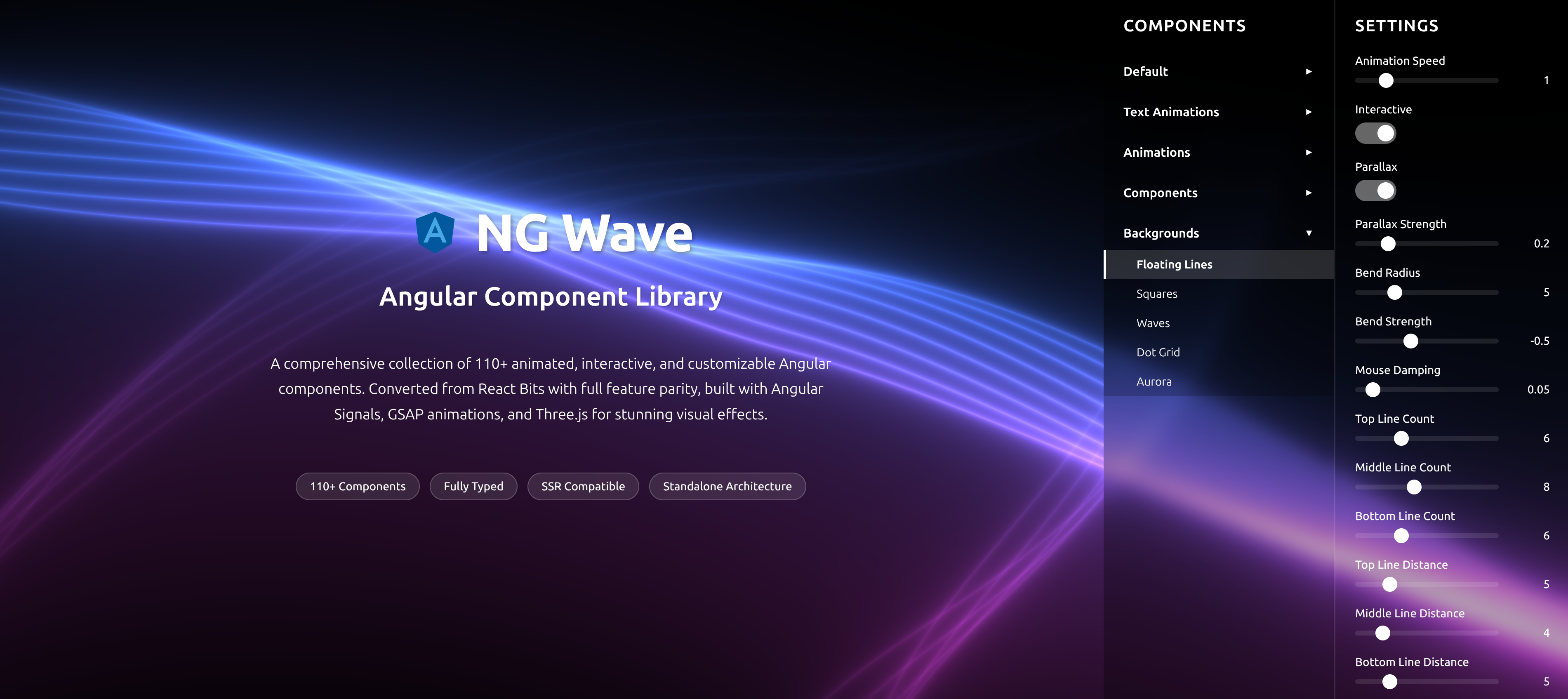
NG Wave
Angular Component Library
A comprehensive collection of 110+ animated, interactive, and customizable Angular components. Converted from React Bits with full feature parity, built with Angular Signals, GSAP animations, and Three.js for stunning visual effects.
Explore Components