Retrofit a Design System into a Legacy Angular App (Angular 20+): Token Bridge, Theming Adapters, and a Zero‑Risk Rollout
Unify inconsistent styling in a legacy Angular app without breaking production—design tokens, PrimeNG adapters, Signals/SignalStore, density controls, and feature‑flagged rollout you can measure.
“We unified 120+ screens by changing tokens and adapters—not rewriting components—and shipped zero incidents.”Back to all posts
I’ve walked into more than a few Angular apps where buttons from three eras share the same page. at a leading telecom provider’s ads analytics, a broadcast media network’s VPS scheduler, and even internal a global entertainment company tools, the fastest path to a sane UI wasn’t a redesign. It was a retrofit—layering a design system onto the code we already had without breaking production.
If you need to hire an Angular developer to stabilize a legacy UI, this is the playbook I actually use in Angular 20+ with Signals/SignalStore, PrimeNG, Nx, and Firebase. We’ll unify the visual language (typography, density, accessibility, and the AngularUX color palette), keep performance budgets intact, and give product a zero‑drama rollout.
Your Legacy Angular UI Is a Patchwork. Here’s How We Retrofit a Design System Without Risk.
As companies plan 2025 Angular roadmaps, the lowest‑risk move is to retrofit a unified visual language across existing components, then selectively replace pieces where it’s worth it. That’s how I kept United’s airport kiosk software accessible and stable while we refit screens for offline‑tolerant flows and device peripherals.
The scene I see too often
At a broadcast media network, one page had both PrimeNG and homegrown components, each with conflicting variables. at a leading telecom provider, an analytics view used hard‑coded hex values that broke dark mode and contrast. We couldn’t pause delivery, so we shipped a token bridge and theming adapters under feature flags, and we never took the app down.
Three button styles, two grids, four blues
Accessibility exceptions piling up
No owner for CSS debt
2025 reality
A design system retrofit gives you visual coherence, accessibility, and performance predictability now—no big‑bang rewrite required.
Angular 20+ ships fast; Angular 21 is right around the corner
Budgets are tight; redesigns are rare
Design tokens win because they’re incremental
Why Inconsistent Styling Breaks UX Metrics and Delivery Velocity
Unifying the language—typography, density, colors, and motion—lets your team reason about visuals like you reason about types in TypeScript. Tokens become contracts.
UX metrics degrade
Mixed typographic scales and padding cause layout shifts that punish Core Web Vitals. Inconsistent focus states break keyboard navigation. Rounded vs. sharp corners across panels increase cognitive friction.
CLS jitter from mixed font metrics
AA failures from random colors
Cognitive load from shape inconsistency
Delivery slows
Unified tokens and adapters reduce review churn and make visual diffs meaningful again. That’s how we kept an insurance technology company’s telematics dashboards shipping weekly while polishing the UI.
Design reviews debate pixels, not outcomes
Engineers fork styles per feature
Visual diffs become noisy
Step-by-Step: Token Bridge, Theming Adapters, and Feature‑Flagged Rollout
/* tokens.scss — AngularUX palette + scale */
:root {
  /* AngularUX color palette */
  --ux-color-bg: #0b0f1a;
  --ux-color-surface: #121826;
  --ux-color-text: #e6f0ff;
  --ux-color-primary: #3ba9ff;
  --ux-color-accent: #8b5cf6;
  --ux-color-success: #22c55e;
  --ux-color-warning: #eab308;
  --ux-color-danger: #ef4444;

  /* radius + density */
  --ux-radius-sm: 6px;
  --ux-radius-md: 10px;
  --ux-density: 0; /* -2 compact, 0 cozy, +1 comfortable */

  /* typography scale */
  --ux-font-size-100: 12px;
  --ux-font-size-200: 14px;
  --ux-font-size-300: 16px;
  --ux-font-size-400: 18px;
  --ux-line-200: 1.4;
  --ux-line-300: 1.5;
}

/* PrimeNG adapter: apply tokens without forking components */
.p-component {
  --primary-color: var(--ux-color-primary);
  --text-color: var(--ux-color-text);
  --surface-ground: var(--ux-color-bg);
  --surface-card: var(--ux-color-surface);
  --border-radius: var(--ux-radius-md);
  --focus-ring: 0 0 0 2px color-mix(in srgb, var(--ux-color-primary), white 70%);
}

.p-inputtext, .p-button {
  padding-block: calc(0.5rem + var(--ux-density)*0.1rem);
  border-radius: var(--ux-radius-sm);
}

/* a11y-friendly focus + reduced motion */
:where(button, [tabindex]:not([tabindex="-1"])):focus-visible {
  outline: none;
  box-shadow: var(--focus-ring);
}
@media (prefers-reduced-motion: reduce) {
  * { animation-duration: .001ms !important; transition-duration: .001ms !important; }
}
// ui.store.ts — Signals/SignalStore for theme + density + flags
import { signalStore, withState, withMethods } from '@ngrx/signals';
type UiState = {
theme: 'light'|'dark';
density: 'compact'|'cozy'|'comfortable';
flags: { dsEnabled: boolean };
};
export const UiStore = signalStore(
{ providedIn: 'root' },
withState<UiState>({ theme: 'dark', density: 'cozy', flags: { dsEnabled: false } }),
withMethods((store) => ({
setDensity(d: UiState['density']) {
store.patchState({ density: d });
const v = d === 'compact' ? '-2' : d === 'comfortable' ? '1' : '0';
document.documentElement.style.setProperty('--ux-density', v);
localStorage.setItem('density', d);
},
enableDS(on: boolean) {
store.patchState({ flags: { dsEnabled: on } });
document.documentElement.classList.toggle('ds-on', on);
}
}))
);// flags.service.ts — Firebase Remote Config to gate rollout
import { Injectable, inject } from '@angular/core';
import { RemoteConfig, fetchAndActivate, getValue } from '@angular/fire/remote-config';
import { UiStore } from './ui.store';
@Injectable({ providedIn: 'root' })
export class FlagsService {
private rc = inject(RemoteConfig);
private ui = inject(UiStore);
async hydrate() {
await fetchAndActivate(this.rc);
const on = getValue(this.rc, 'ds_enabled').asBoolean();
this.ui.enableDS(on);
}
}// highcharts-theme.ts — unify data viz with tokens
import * as Highcharts from 'highcharts';
function cssVar(name: string) {
return getComputedStyle(document.documentElement).getPropertyValue(name).trim();
}
export function applyHighchartsTheme() {
Highcharts.setOptions({
chart: { backgroundColor: cssVar('--ux-color-surface') },
title: { style: { color: cssVar('--ux-color-text'), fontSize: cssVar('--ux-font-size-300') } },
colors: [cssVar('--ux-color-primary'), cssVar('--ux-color-accent'), '#22c55e', '#eab308']
});
}# .github/workflows/visual-regression.yml
name: visual-regression
on:
pull_request:
paths: ['apps/**/src/**/*.scss','libs/ui/**']
jobs:
percy:
runs-on: ubuntu-latest
steps:
- uses: actions/checkout@v4
- uses: pnpm/action-setup@v3
with: { version: 9 }
- run: pnpm install
- run: pnpm nx run demo-e2e:e2e --headed=false
- run: npx percy exec -- pnpm nx run demo-e2e:snapshots
env:
PERCY_TOKEN: ${{ secrets.PERCY_TOKEN }}// angular.json — keep style budgets honest
"budgets": [
{ "type": "bundle", "name": "styles", "maximumWarning": "200kb", "maximumError": "260kb" }
]1) Token bridge first
Start by declaring CSS variables with the AngularUX color palette and a rational type scale. Use them to override legacy SCSS maps or CSS classes behind the scenes.
Define color/typography/radius/spacing/density tokens
Map legacy variables/classes to tokens
Ship tokens dark—zero visual change initially
2) Theming adapters for PrimeNG/Material
PrimeNG and Angular Material both respond to CSS variables. Create an adapter layer that feeds tokens into library theming variables. Replace hard‑coded colors with tokens.
No forking components
Adapters translate tokens to library variables
Apply at .p-component scope to contain impact
3) Density and typography via Signals/SignalStore
Use a SignalStore to toggle density and type scale preferences. Values are reflected as CSS variables so SSR hydration remains deterministic.
Density modes: compact, cozy, comfortable
Persist per user/tenant
Server‑safe: tokens live in CSS, not client code
4) Feature flags with Firebase Remote Config
Roll out the design system layer gradually. Start with low‑risk surfaces (buttons, inputs), then tables and complex widgets.
Canary per role/tenant/route
Instant off switch if metrics regress
No redeploy for toggles
5) Visual regression and budgets
Capture before/after screens and fail the build on unintended diffs. Keep your styles budget honest and track CLS/LCP changes in GA4 or Firebase Analytics.
Percy/Chromatic snapshots in CI
Lighthouse budgets for styles bundle
Analytics events for UX changes
Accessibility, Typography, and Density Controls That Survive Production
Good UX polish doesn’t blow your performance budget. CSS tokens are nearly free at runtime, SSR‑safe, and keep your JS lean. Motion settings obey prefers‑reduced‑motion to respect accessibility without extra code paths.
Contrast and focus you can trust
Ship a palette that passes AA by default. Use a single focus‑ring token so every interactive element looks consistent.
AA contrast across modes
Visible focus with color‑mix rings
Keyboard traps linted in CI
Type scale that avoids CLS
Using a rational type scale (12/14/16/18) and matching line heights prevents layout shifts. Preload critical fonts and use font‑display: swap to avoid FOIT.
Consistent font metrics
Line height tokens per tier
Load fonts early (swap)
Density modes per role
at a major airline, kiosk flows ran in comfortable mode with larger touch targets. at a leading telecom provider, analysts wanted dense tables for D3/Highcharts overlays. Tokens made both possible without diverging CSS.
Analysts prefer compact tables
Kiosk users need comfortable hit targets
Persist per tenant/role
Unifying D3/Highcharts/Canvas Themes with Design Tokens
The payoff: role‑based dashboards that feel cohesive—from navigation to charts to virtualized grids—without rewriting a single chart component.
Data viz that matches the UI
If charts ignore your palette, the page still looks inconsistent. Feed tokens into visualization libraries so legends, axes, and focus states all align.
D3 scales read CSS vars
Highcharts theme on app bootstrap
Canvas/Three.js colors sourced from tokens
Virtualization without visual drift
Virtualized tables often drift in spacing and focus outlines. Apply density tokens at the container so recycled rows inherit the same visual language.
CDK Virtual Scroll for large lists
Row density + sticky headers kept consistent
Tooltips/focus managed globally
Case Notes from a global entertainment company, Charter, and a broadcast media network: Zero‑Incident Rollouts
I apply the same playbook across industries—media, telecom, aviation, finance—because it scales. If you need an Angular expert to get this done under production load, I can help.
a global entertainment company employee/payments tooling
We swapped hexes for tokens and rolled out role‑based density. Accessibility audits passed without a redesign.
Token bridge shipped first
Focus-visible fixed a11y debt
No downtime
Charter ads analytics
Charts, tables, and filters finally matched. Product noticed the reduced design debate more than the new colors.
PrimeNG adapters over forking
Highcharts theme unified visuals
Visual regression kept us honest
a broadcast media network VPS scheduler
Feature flags let us pilot per team, then expand. CLS dropped once font metrics and paddings were consistent.
Firebase flags for canaries
Dark mode arrived with zero incidents
Measurable CLS improvement
When to Hire an Angular Developer for Legacy Rescue
If you’re looking to hire an Angular developer or Angular consultant, I’m available for select remote engagements. We can start with a 30‑minute review of your UI debt and a plan to retrofit safely.
Signals it’s time
If your app ships features slower because of styling contention, it’s cheaper to unify the language now than to keep negotiating pixels later.
Design debt blocks delivery
AA violations keep reopening tickets
Multiple UI libraries fight for control
What I do in week one
In 2–4 weeks, we can stabilize the look-and-feel, flip on canaries, and prove improvements with metrics. See how I can help you stabilize your Angular codebase via my code rescue practice at gitPlumbers—99.98% uptime while modernizing.
Audit tokens, typography, and density
Map PrimeNG/Material adapters
Stand up flags + CI visual tests
How an Angular Consultant Retrofits a Design System in Angular 20+
This is the same approach I used with kiosk software at a major airline (Docker‑simulated peripherals, offline‑tolerant UX) and telematics dashboards at an insurance technology company. Polished UX coexists with engineering rigor and performance budgets.
Architecture in Nx
Modularizing tokens and adapters keeps changes isolated. A single import enables the new theme across apps.
libs/ui-tokens, libs/ui-adapters, libs/ui-theme
Adapter components wrap PrimeNG/Material
Strict TypeScript + stylelint rules
Telemetry + guardrails
We treat visual changes like backend migrations: observable, reversible, and backed by telemetry.
Sentry/OpenTelemetry signals on UI errors
GA4/Firebase events for CLS/LCP deltas
Rollback plan tied to flags
Delivery cadence
Resist the urge to rewrite. Adapters and tokens deliver 80% of the value with 20% of the risk. Replacements come later, with data.
Pilot on non‑critical surfaces
Expand per route/tenant
Replace components last, not first
Key Takeaways and Next Steps
- Start with a token bridge; prove the concept without visual change.
- Introduce theming adapters for PrimeNG/Material and wrap a few high‑impact components.
- Control rollout with Firebase flags; store preferences via Signals/SignalStore.
- Enforce accessibility, typography, and density standards from the token layer.
- Measure with visual regression and UX metrics; keep a rollback switch ready.
If you want a second set of eyes on your legacy UI, let’s review your Angular build and plan a design system retrofit that won’t break production.
FAQ: Cost, Timeline, and Risk
If you need a remote Angular developer with a global entertainment company/United/Charter experience, I’m an Angular consultant available now. We can start with a small audit and expand if it’s a fit.
How long does a retrofit take?
For a typical enterprise dashboard, 2–4 weeks for token/adapter rollout and canaries. Full component replacement (if needed) runs in parallel later.
Will this break production?
No—tokens ship dark, adapters run under flags, and CI snapshots guard against regressions. We keep a fast rollback via Remote Config.
Do we need to upgrade Angular first?
Not necessarily. This approach works on Angular 12–20+. If you want to upgrade, we can plan that separately with zero downtime.
Key takeaways
- Start with tokens, not components: ship a token bridge that maps your legacy styles to a unified palette.
- Introduce theming via adapters for PrimeNG/Material; don’t fork components until metrics prove the need.
- Gate rollout with feature flags (Firebase Remote Config) and use Signals/SignalStore to toggle at runtime.
- Bake in accessibility: contrast‑safe palette, focus rings, typography scale, and density modes.
- Measure everything: Lighthouse budgets, visual regression, GA4/Firebase events, and error budgets for safe rollout.
Implementation checklist
- Create a token bridge: color, spacing, radius, typography, density variables.
- Apply PrimeNG/Material adapters that read tokens via CSS variables.
- Build a UiStore (SignalStore) to switch theme/density and respond to flags.
- Wrap a few high‑impact components (button/input/table) with adapter components.
- Enable canary rollout per tenant/role via Firebase Remote Config.
- Add visual regression snapshots and Lighthouse budgets in CI.
- Instrument UX metrics (CLS/LCP), focus-visible, and reduced-motion media queries.
- Update data viz themes (Highcharts/D3/Canvas) to read the same tokens.
- Deprecate legacy classes with lint rules and codemods; remove dead CSS incrementally.
Questions we hear from teams
- How much does it cost to hire an Angular developer for a design system retrofit?
- Most retrofits start with a 2–4 week engagement focused on tokens, adapters, and flags. Budget ranges from $12k–$40k depending on scope, CI setup, and data viz integration.
- What does an Angular consultant do during week one?
- Audit tokens/typography/density, set up PrimeNG/Material adapters, configure Firebase flags, add visual regression tests, and define UX metrics. You’ll see a canary within days.
- How long does an Angular design system retrofit take?
- Token bridge and theming adapters usually ship in 2–4 weeks. Component replacements are staged later, if necessary, without blocking delivery.
- Will design tokens impact performance or SSR?
- No. CSS variables are SSR‑safe and lightweight. Signals/SignalStore only reflect preferences; tokens live in CSS so hydration stays deterministic.
- Can this work in a multi‑tenant app?
- Yes. Use role/tenant‑aware flags and store preferences per tenant. I’ve applied this at a leading telecom provider and a broadcast media network to roll out themes safely across tenants and roles.
Ready to level up your Angular experience?
Let AngularUX review your Signals roadmap, design system, or SSR deployment plan.
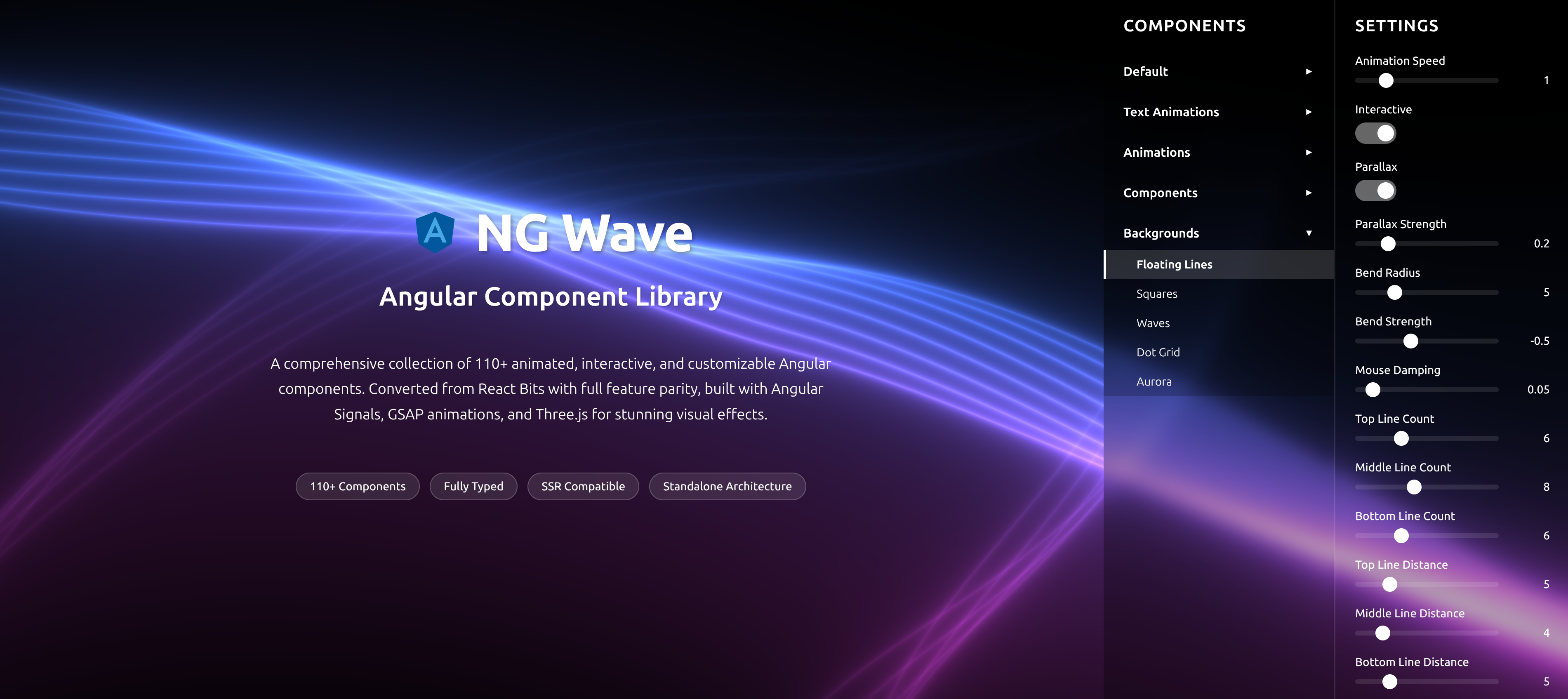
NG Wave
Angular Component Library
A comprehensive collection of 110+ animated, interactive, and customizable Angular components. Converted from React Bits with full feature parity, built with Angular Signals, GSAP animations, and Three.js for stunning visual effects.
Explore Components