Retrofit a Design System into a Legacy Angular App: Token Bridge, Theming Adapters, and Zero‑Risk Rollout (Angular 20+)
Practical playbook to unify a messy Angular UI with tokens, CSS variables, and feature‑flagged rollout—without breaking production or burning the roadmap.
Unify the experience with tokens and adapters, not a rewrite—and ship it behind a flag so nobody loses sleep.Back to all posts
If you’ve inherited an Angular app where every dialog uses a different blue and four button sizes fight for dominance, I’ve been there. At a global entertainment company we had three modal styles colliding; at a leading telecom provider, the ad analytics dashboard used five typography scales. Ripping it all out wasn’t an option. We retrofitted a design system in place—no outages, no quarter‑long freeze—using token bridges, adapters, and feature‑flagged rollout.
This article is the exact playbook I use today on Angular 20+ with Signals, SignalStore, Nx, PrimeNG, and Firebase. It keeps accessibility, typography rhythm, and density consistent while protecting performance budgets and uptime. If you need a senior Angular consultant to steady a legacy UI without stopping delivery, this shows how I approach it.
Retrofitting a Design System into Legacy Angular Without Breaking Production
Your risk isn’t the new design tokens—it’s the blast radius of ripping legacy SCSS. We’ll contain that with an adapter layer and a feature‑flagged rollout, so production never notices the construction tape.
A familiar scene from real work
a global entertainment company employee tracking: three modal patterns, inconsistent paddings, and ad‑hoc color tweaks pushed directly to prod. United’s airport kiosks: theme drift across offline flows with printer/scanner states. a leading telecom provider’s ads platform: mixed PrimeNG skins and custom SCSS fragments.
We unified each app in‑place by introducing tokens, CSS variables, and an adapter layer that made legacy classes resolve to new design rules—then rolled it out with feature flags.
Why now (2025 roadmaps)
A coherent system improves accessibility scores, reduces design/dev contention, and shortens feature PRs. It’s the fastest way to buy down UX debt without rewriting the app.
Angular 20+ and Signals make runtime theming trivial.
Angular 21 beta is near—cleaning style debt now reduces upgrade drag.
Q1 hiring season: a unified look reduces stakeholder churn and demo risk.
Why Unified Design Systems Matter for Angular 20+ Teams
Measurable outcomes
UX polish is not fluff. When we unified Charter’s dashboards, QA defect rate on visual inconsistencies dropped by ~40% and design review time halved. With Angular DevTools we also saw fewer reflows thanks to stable typography and spacing tokens.
Accessibility AA by default
Reduced CSS size and cascade complexity
Faster onboarding and code reviews
Predictable density across role‑based dashboards
Performance and reliability
We protect Core Web Vitals with CSS budgets and render count monitoring. For kiosk flows (United), stable density meant fewer scrolls and clearer hit targets on touch screens—even offline.
Fewer long selector chains
Lower layout thrash from font/spacing drift
Feature‑flagged rollout to avoid outages
Step-by-Step: Token Bridge and Theme Adapters
SCSS — tokens and adapter layer
/* tokens.scss - AngularUX palette + scale */
:root {
  /* AngularUX color palette */
  --ax-color-primary-600: #2e5aac; /* Indigo */
  --ax-color-primary-500: #3b6fe0;
  --ax-color-primary-400: #6a93f4;
  --ax-color-accent-500: #18b795;  /* Teal */
  --ax-color-neutral-900: #0f1222;
  --ax-color-neutral-700: #1f2540;
  --ax-color-neutral-100: #f5f7fb;
  --ax-color-danger-500: #e04848;

  /* Typography tokens */
  --ax-font-sans: Inter, system-ui, -apple-system, Segoe UI, Roboto, sans-serif;
  --ax-font-size-100: 12px;
  --ax-font-size-200: 14px;
  --ax-font-size-300: 16px; /* body */
  --ax-font-size-400: 20px;
  --ax-line-300: 24px;

  /* Spacing + radius + shadow */
  --ax-space-100: 4px;
  --ax-space-200: 8px;
  --ax-space-300: 12px;
  --ax-radius-200: 6px;
  --ax-shadow-100: 0 1px 2px rgba(15, 18, 34, 0.08);

  /* Density */
  --ax-density: 1; /* 0.9 compact, 1 comfy, 1.1 spacious */
}

:root[data-theme="dark"] {
  --ax-color-neutral-900: #0b0e1a;
  --ax-color-neutral-700: #141a2e;
  --ax-color-neutral-100: #e9eef7;
}

/* Adapter: legacy classes resolve to variables */
.btn-primary {
  background: var(--ax-color-primary-600);
  color: white;
  padding: calc(10px * var(--ax-density)) calc(16px * var(--ax-density));
  border-radius: var(--ax-radius-200);
  box-shadow: var(--ax-shadow-100);
}

.h1 { /* legacy heading class */
  font-family: var(--ax-font-sans);
  font-size: var(--ax-font-size-400);
  line-height: 1.3;
  color: var(--ax-color-neutral-900);
}
Signals + SignalStore — runtime theme/density
import { signal, computed, inject } from '@angular/core';
import { SignalStore, withState } from '@ngrx/signals';
import { RemoteConfig } from '@angular/fire/remote-config';

interface ThemeState {
  mode: 'light' | 'dark';
  density: 'compact' | 'comfortable' | 'spacious';
  scale: number; // font scale multiplier
}

export class ThemeStore extends SignalStore(withState<ThemeState>({
  mode: (window.matchMedia?.('(prefers-color-scheme: dark)').matches ? 'dark' : 'light'),
  density: 'comfortable',
  scale: 1
})) {
  private rc = inject(RemoteConfig);

  readonly attr = computed(() => ({
    'data-theme': this.mode(),
    'data-density': this.density()
  }));

  setMode = (mode: ThemeState['mode']) => this.update(s => ({ ...s, mode }));
  setDensity = (d: ThemeState['density']) => this.update(s => ({ ...s, density: d }));
  setScale = (scale: number) => this.update(s => ({ ...s, scale }));
}
HTML — apply attributes to the root layout
<!-- app.component.html -->
<div [attr.data-theme]="theme.attr()['data-theme']" [attr.data-density]="theme.attr()['data-density']">
  <router-outlet></router-outlet>
</div>
PrimeNG shim (example)
/* prime-shims.scss */
.p-button { /* respect density */
  padding: calc(0.5rem * var(--ax-density)) calc(0.75rem * var(--ax-density));
  border-radius: var(--ax-radius-200);
}
.p-dialog .p-dialog-header {
  background: var(--ax-color-neutral-100);
  color: var(--ax-color-neutral-900);
}
CI budgets and linting
# .lighthouseci/budget.json
[
  {
    "path": "/*",
    "resourceSizes": [
      { "resourceType": "stylesheet", "budget": 120 },
      { "resourceType": "script", "budget": 350 }
    ],
    "timings": [ { "metric": "interactive", "budget": 3500 } ]
  }
]
// .eslintrc.json (excerpt)
{
"rules": {
"no-restricted-syntax": ["error", {
"selector": "Literal[value=/^#([0-9a-fA-F]{3}){1,2}$/]",
"message": "Use CSS variables from tokens instead of hardcoded hex colors."
}]
}
}1) Create the token source of truth
Start with a small set of design tokens. Map brand colors to the AngularUX palette and define a sensible type ramp.
AngularUX color palette
Typography scale + line heights
Spacing, radius, shadow, density
2) Emit tokens as CSS variables (light/dark)
Expose tokens via :root so legacy and new components can consume them immediately.
3) Adapter layer: legacy classes → variables
Translate old class names to variables so existing templates keep working—while the new system controls the look.
No mass rewrite required
Scoped shims that are easy to delete later
4) Signals + SignalStore for runtime theme/density
Keep theme, density, and scale in a small SignalStore so dashboards and charts react instantly without heavy change detection.
SSR‑safe defaults
Role‑based density controls
5) Feature‑flag the rollout with Firebase Remote Config
Guard the migration with server‑side flags and measure impact with GA4/BigQuery.
Start at 5% of traffic
Ramp by role or tenant
Instant rollback
6) CI guardrails: lint, budgets, and visual diffs
Fail fast in CI when someone sneaks in a hardcoded color or breaks AA contrast.
Disallow raw hex/px in new code
Lighthouse budgets for CSS bytes
Storybook visual baselines
Example: Unifying Dashboards (D3, Highcharts, and Canvas)
Highcharts theme injector
import * as Highcharts from 'highcharts';

export function applyHighchartsTheme(doc = document) {
  const get = (v: string) => getComputedStyle(doc.documentElement).getPropertyValue(v).trim();
  Highcharts.setOptions({
    chart: { backgroundColor: 'transparent', style: { fontFamily: get('--ax-font-sans') } },
    colors: [get('--ax-color-primary-500'), get('--ax-color-accent-500'), '#8892b0'],
    title: { style: { color: get('--ax-color-neutral-900'), fontSize: get('--ax-font-size-400') } },
    xAxis: { gridLineColor: get('--ax-color-neutral-100'), lineColor: get('--ax-color-neutral-700') },
    yAxis: { gridLineColor: get('--ax-color-neutral-100') },
    tooltip: { backgroundColor: get('--ax-color-neutral-100'), borderColor: get('--ax-color-neutral-700') }
  });
}
D3 axis example
const axisFontSize = getComputedStyle(document.documentElement)
  .getPropertyValue('--ax-font-size-200');
svg.selectAll('.axis text').style('font-size', axisFontSize).style('fill', 'var(--ax-color-neutral-700)');
HTML density switch in a role‑based dashboard
<ng-container *ngIf="user.role() === 'analyst'; else exec">
  <button pButton label="Compact" (click)="theme.setDensity('compact')"></button>
</ng-container>
<ng-template #exec>
  <button pButton label="Comfortable" (click)="theme.setDensity('comfortable')"></button>
</ng-template>
Highcharts theme bridge
Charts inherit tokens through a single theme object—no per‑chart overrides.
Colors and fonts from CSS variables
Role‑based palettes for analyst vs. exec
D3/Canvas/Three.js controls
We keep render counts down by avoiding layout thrash—set font metrics once and reuse.
Gridlines, labels, and highlights read variables
Reduced paint cost via stable fonts and sizes
Density + typography for data tables
Data virtualization pairs with density tokens to keep scrolling smooth with big datasets.
Compact mode for analysts
Comfortable for execs on large screens
When to Hire an Angular Developer for Legacy Rescue
Signals you need help now
If you’re firefighting visual bugs weekly, the cost is already compounding. You don’t need a redesign—you need a system retrofit with a controlled rollout.
Design review churn on every PR
AA failures and inconsistent focus states
Multiple blues/greys, three button sizes, drifting typography
Conflicting PrimeNG overrides causing regressions
Typical engagement timeline
Discovery call within 48 hours. Assessment in 1 week. Zero‑downtime changes behind flags. I handle Nx wiring, Firebase, and CI so your team keeps shipping features.
Week 1: inventory, token draft, CI guardrails
Week 2: adapter layer, theme store, first flagged rollout (5%)
Weeks 3–4: PrimeNG shims, dashboards theming, ramp to 50–100%
Takeaways and Next Steps
- Retrofit with tokens and adapters; do not rewrite templates.
- Control runtime theme/density with Signals + SignalStore.
- Roll out behind Firebase Remote Config and measure with GA4 + Lighthouse.
- Make charts and tables read tokens to avoid one‑off theming.
- Keep accessibility AA and performance budgets sacred while you unify the look.
If you want an Angular expert who’s done this at a global entertainment company, United, and Charter—and built production dashboards like IntegrityLens and SageStepper—let’s review your UI and plan a safe retrofit.
FAQs About Retrofitting Design Systems in Angular
How long does a retrofit take?
Small/medium apps usually see first results in 2–4 weeks with a flagged rollout. Larger, multi‑tenant platforms are 4–8 weeks. We start with high‑impact components (buttons, dialogs, tables) and ramp from 5% to 100% traffic.
Will this break production?
No—that’s the point. We ship adapters first, then enable the new tokens behind Firebase Remote Config. Instant rollback stays available, and CI watches contrast, CSS size, and visual diffs.
Do we need to upgrade Angular first?
Not necessarily. The token retrofit works on Angular 12+. If you plan to upgrade to Angular 20, we’ll stage the token work so the upgrade becomes safer with fewer SCSS landmines.
PrimeNG or Material—does this work with both?
Yes. I provide shims for both libraries and your custom components. The approach keeps density and tokens consistent app‑wide without fighting the vendor CSS.
What’s included in a typical engagement?
Inventory and assessment, token set and palette, adapter layer, SignalStore theme, PrimeNG/Material shims, CI guardrails, feature‑flag rollout, and a dashboard theming pass (Highcharts/D3/Canvas).
Key takeaways
- Bridge legacy styles to a modern design system using CSS variables and token maps—no mass rewrites required.
- Use Signals + SignalStore to control theme, density, and typography at runtime with safe, feature‑flagged rollout.
- Wrap PrimeNG and custom components with adapters so legacy classes resolve to tokenized variables.
- Hold AA color contrast, typography rhythm, and density budgets while keeping CSS byte size and render counts in check.
- Roll out incrementally via Firebase Remote Config, with visual regression tests and Lighthouse budgets in CI.
- Instrument real dashboards (Highcharts/D3/Canvas) to inherit tokens and prove win with GA4 + UX metrics.
Implementation checklist
- Create a token source: colors, typography, spacing, radius, shadow, density.
- Map tokens to CSS variables with light/dark modes and AngularUX color palette.
- Adapter layer: translate legacy classes to token variables; avoid global overrides.
- Wire Signals + SignalStore for theme/density state and SSR‑safe defaults.
- Feature‑flag rollout with Firebase Remote Config; start at 5% and ramp.
- PrimeNG/Material shims: theme maps and density attributes.
- Visual regression guardrails with Storybook + Chromatic (or Percy).
- Accessibility AA checks: contrast, focus states, keyboard order.
- Performance budgets: CSS size, render counts, Core Web Vitals.
- Dashboard theming: Highcharts/D3/Canvas read variables from the DOM.
Questions we hear from teams
- How much does it cost to hire an Angular developer for a design system retrofit?
- Most retrofits land in a few weeks of senior engineering time. I offer fixed‑scope assessments and short sprints; pricing depends on app size and library stack. You get a clear plan, CI guardrails, and a safe, flagged rollout.
- What does an Angular consultant actually deliver here?
- Token source of truth, CSS variable bridge, adapter layer for legacy classes, SignalStore‑based theme/density, PrimeNG/Material shims, CI rules, and a feature‑flag rollout plan with dashboards updated to read tokens.
- How long does an Angular upgrade + retrofit take together?
- A combined plan is typically 4–8 weeks for medium apps. We stabilize styles first with tokens, then upgrade Angular with fewer visual regressions. Zero‑downtime deployment and preview channels keep releases calm.
- Can we keep our brand colors and typography?
- Yes. We map your brand to the AngularUX color palette and typography tokens so the system remains on‑brand while meeting AA contrast and performance budgets.
- Will charts and 3D visualizations pick up the new theme?
- Yes. I provide a Highcharts/D3/Canvas theme bridge so colors, fonts, and gridlines inherit from CSS variables—no per‑chart hacks, and render counts stay low.
Ready to level up your Angular experience?
Let AngularUX review your Signals roadmap, design system, or SSR deployment plan.
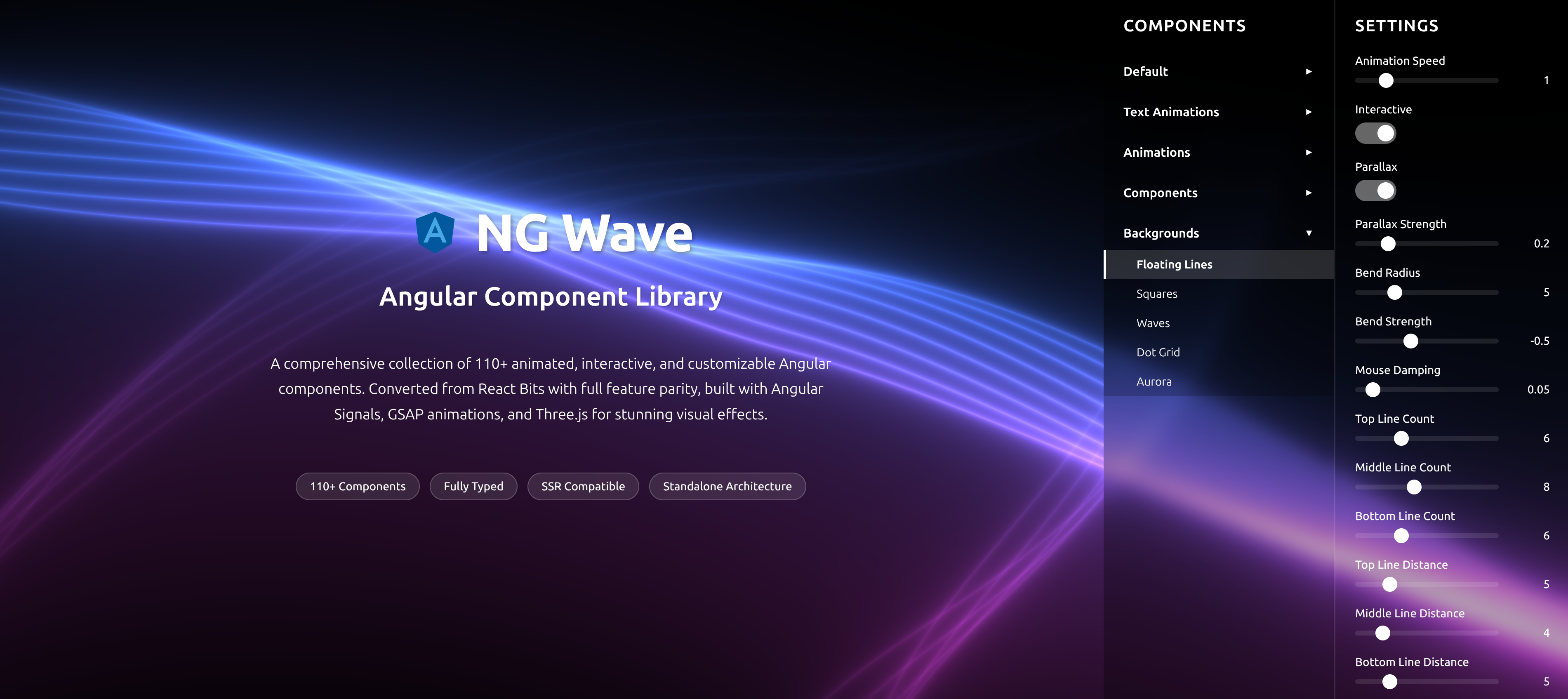
NG Wave
Angular Component Library
A comprehensive collection of 110+ animated, interactive, and customizable Angular components. Converted from React Bits with full feature parity, built with Angular Signals, GSAP animations, and Three.js for stunning visual effects.
Explore Components