Running Offshore Angular 20+ Teams That Ship: Code Reviews, Sprint Cadence, Test Strategy, and a Standard Nx Playbook
What I enforce to keep distributed Angular teams fast, predictable, and measurable—Signals/SignalStore, Nx, PrimeNG, Firebase, and CI guardrails that scale across time zones.
Consistency beats heroics. Standardize the path, make it measurable, and offshore Angular teams will quietly outrun your onshore velocity.Back to all posts
If you manage offshore Angular teams, consistency is your multiplier. I’ve led distributed squads for a global entertainment company, a telecom analytics platform, and airport kiosks—what scales isn’t heroics; it’s a standard playbook with clear guardrails.
Below is the platform-and-delivery system I drop into Angular 20+ orgs: a reusable Nx architecture, a ruthless but fair code review rubric, sprint ceremonies that respect time zones, and a test strategy that keeps quality high without freezing delivery.
The 2 a.m. PR That Blocked Your Release (And How We Avoid It)
As companies plan 2025 Angular roadmaps, offshore teams are a force multiplier only if the architecture and reviews are standardized. The goal: smaller PRs, predictable ceremonies, and measurable UX. If you need an Angular consultant or want to hire an Angular developer to set this up, this is exactly what I deliver.
The pattern I see
I’ve been paged at 2 a.m. because a 1,200-line PR from an offshore team blocked a release. The fix wasn’t more hours; it was guardrails. Today, every distributed team I lead ships with the same playbook: Nx scaffolds, Signals/SignalStore patterns, CI checks, and preview channels—so ambiguity can’t creep in.
PRs too big, no owner, no preview
Architecture drifts per engineer
Flaky e2e hides real regressions
Tooling that keeps us honest
We unify how modules, stores, tests, and routes are created. CI enforces size, tests, and budgets. Every PR spins a Firebase preview so reviewers and PMs can verify UX without guessing.
Nx generators for structure
GitHub Actions for checks
Firebase previews per PR
Why Offshore Angular Teams Stall Without Guardrails
Guardrails reduce variance, not creativity. Engineers still solve problems; they just do it with a consistent set of building blocks and measurable outcomes.
Common failure modes
Without a standard, teams ship different patterns for state, HTTP, and routing. Reviews become taste debates, and e2e tests mask real regressions. The result: cycle time sprawl and production surprises.
Architectural drift: each squad invents patterns
Review churn: subjective feedback
Test noise: slow, flaky e2e
The antidote
We make the right path the easy path: generators stamp out the same module/store/test setup; reviews follow a rubric; tests focus where value is highest.
Codify architecture via generators
Objective review rubric
Lean test pyramid + emulators
Set the Standard: Nx Architecture and Generators for Consistency
Example SignalStore pattern I stamp into distributed teams:
import { Injectable, computed, inject } from '@angular/core';
import { signalStore, withState, withComputed, withMethods } from '@ngrx/signals';
import { Employee } from '@shared/models';
import { EmployeesApi } from '@shared/util-http';

interface EmployeeState {
  entities: Record<string, Employee>;
  selectedId: string | null;
  loaded: boolean;
}

const initialState: EmployeeState = {
  entities: {},
  selectedId: null,
  loaded: false,
};

@Injectable({ providedIn: 'root' })
export class EmployeeStore extends signalStore(
  withState(initialState),
  withComputed(({ entities, selectedId, loaded }) => ({
    selected: computed(() => (selectedId() ? entities()[selectedId()!] : null)),
    count: computed(() => Object.keys(entities()).length),
    isReady: computed(() => loaded()),
  })),
  withMethods((store) => {
    const api = inject(EmployeesApi);
    return {
      async load() {
        const list = await api.fetchAll();
        store.setState((s) => ({
          ...s,
          entities: list.reduce((acc, e) => ({ ...acc, [e.id]: e }), {}),
          loaded: true,
        }));
      },
      select(id: string | null) { store.patchState({ selectedId: id }); },
    };
  })
) {}
Workspace layout
This layout keeps domain logic separate from UI, and shared code truly shared. Shells handle routing and role gating; domain libs own business rules.
apps/portal (shell)
libs/domain-employee, domain-telemetry
libs/ui-components (PrimeNG wrappers)
libs/shared/util-http, shared/models
SignalStore default pattern
We standardize on SignalStore so every team reads the same mental model: state → derived selectors → methods.
withState + withComputed + withMethods
No HttpClient in components
Selectors exported for testing
Ship generators
Generators stop bikeshedding. Every feature ships the same files, names, providers, and tests.
nx g app-shell, nx g domain-store
Schematics for feature, store, facade, tests
Code Reviews that Scale Across Time Zones
GitHub Actions that gate every PR:
name: ci
on:
  pull_request:
    branches: [ main ]
jobs:
  quality:
    runs-on: ubuntu-latest
    steps:
      - uses: actions/checkout@v4
      - uses: pnpm/action-setup@v3
        with: { version: 9 }
      - uses: actions/setup-node@v4
        with:
          node-version: 20
          cache: 'pnpm'
      - run: pnpm install --frozen-lockfile
      - uses: nrwl/nx-set-shas@v4
      - name: Lint/Test/Build affected
        run: pnpm nx affected -t lint test build --parallel=3 --configuration=ci
      - name: Enforce bundle budgets
        run: pnpm nx run portal:build --configuration=ci --verbose
      - name: Deploy Firebase preview
        uses: FirebaseExtended/action-hosting-deploy@v0
        with:
          repoToken: '${{ secrets.GITHUB_TOKEN }}'
          firebaseServiceAccount: '${{ secrets.FIREBASE_SERVICE_ACCOUNT }}'
          projectId: my-enterprise
          channelId: pr-${{ github.event.number }}
Add CODEOWNERS and branch protection so the right people must approve. Track PR cycle time; aim for <24h median across time zones.
PR template + rubric
Reviews are asynchronous and objective. If it’s not checked, it’s not done. Screenshots or preview links are mandatory for UI changes.
Scope, risk, screenshots
Checklist: a11y, tests, budgets
Ownership: who can merge
Automation
CI enforces PR size (<400 LOC changed), runs affected tests, verifies bundle budgets, and posts a Firebase preview URL.
Block oversized PRs
Label by scope
Require coverage
Sprint Ceremonies for Distributed Teams
Good ceremonies keep everyone aligned without burning hours. When rigor is consistent, offshore teams feel confident and velocity goes up.
Cadence that respects time zones
We schedule a thin overlap window. Outside that, updates happen in writing with clear blockers and next steps.
Daily standup: 15 minutes overlap
Planning: UTC-first agenda
Asynchronous updates allowed
Definition of Ready/Done
Tickets aren’t pulled unless they have acceptance criteria, test strategy, and telemetry events listed. Done requires a preview link and basic a11y checks.
Ready: design/acceptance/telemetry defined
Done: tests, preview, a11y check, docs
Demos with metrics
Every demo, we show impact, not just features. I’ve used this in telecom ad analytics and employee tracking; leadership sees progress and quality in one snapshot.
Show Core Web Vitals deltas
Show PR cycle time
Show defect leakage
Test Strategy: From Signals Stores to E2E on Firebase Emulators
Basic emulator boot in CI:
firebase emulators:start --only auth,firestore --project demo --import=./test-data --export-on-exitKeep flaky test rate <2%. If it rises, quarantine the suite and fix before merging.
Pyramid and priorities
We test business logic where it’s cheap and fast. Components get focused tests. E2e is reserved for 4–6 critical flows.
Unit SignalStore and pure functions first
Component tests (Cypress) for UI states
Lean e2e: golden paths only
Firebase Emulator Suite in CI
For apps on Firebase, I wire emulators so PRs validate security rules and data contracts without hitting prod. This cut our escaped defects by ~30% at a media network.
Auth/Firestore rules tested
Deterministic data seeding
Contract tests per collection
Hardware labs via Docker
For a major airline kiosk project, we Dockerized peripheral APIs so offshore teams could reproduce bugs. It slashed defect reproduction time from days to hours.
Simulate scanners/printers
Reproduce kiosk bugs in CI
Offline/online state tests
CI/CD Blueprint: GitHub Actions, Nx Caching, and Preview Channels
Add budgets to angular.json and run Lighthouse CI on the Firebase preview URL. Use Storybook + Chromatic for visual diffs of PrimeNG components; it catches regressions when teams sleep.
Speed with accuracy
Caching and affected graphs keep CI fast. I typically use GCP or AWS for remote cache and split verification from deployment stages.
Nx remote cache (GCS/S3/Azure)
Affecteds only
Separate verify vs. deploy jobs
Budgets and a11y gates
We prevent regressions: bundle sizes, Core Web Vitals, and basic a11y run on PR. At a B2B SaaS, this helped us hold 0.02 CLS and improve LCP by 43%.
Angular budgets per app
Lighthouse CI for LCP/INP/CLS
axe-core checks in Storybook
When to Hire an Angular Developer for Legacy Rescue
Bring in an Angular consultant when your team spends more time negotiating patterns than shipping features. The ROI shows up in PR cycle time and escaped defect rates within two sprints.
Signals you need help now
If you’re here, you likely need a standard. I’m a remote Angular contractor who stabilizes codebases without a feature freeze—Nx, Signals/SignalStore, CI, and a test strategy you can trust. See how we stabilize your Angular codebase at gitPlumbers.
Angular versions drifted across apps
PRs average >800 LOC, >5 days to merge
Flaky e2e hides production issues
Fast path to stabilization
We don’t stop shipping. We wrap the monolith with guardrails, then replace hotspots incrementally.
Week 1: audit + plan
Week 2–3: generators, CI, reviews
Week 4+: migrate features + train leads
How an Angular Consultant Standardizes in 2 Weeks
Expect to see PR cycle time drop 30–50% and coverage on critical paths climb without slowing feature work. My products—gitPlumbers (99.98% uptime), IntegrityLens (12k+ interviews), and SageStepper (+28% score lift, 320 communities)—follow this exact approach.
Day 1–3: Audit
I run Angular DevTools and flame charts, extract Core Web Vitals, and map hotspots. We agree on a minimal, enforceable standard.
Nx graph, bundle analysis, flaky test map
Architecture drift report
Day 4–7: Generators + CI
We lock in the scaffolds and the rules. From now on, every PR looks familiar.
Feature/store generators
PR template, CODEOWNERS, budgets
Day 8–10: Training + pilot
We train offshore leads on the playbook and ship a small feature end-to-end with previews, tests, and demo metrics.
Pilot team ships two features
Metrics dashboards in GA4
Measurable Outcomes and What to Instrument Next
Keep improving the system, not just the code. Offshore teams thrive when their process is observable and adjustable.
Track these weekly
Publish a short delivery report tied to demos. If a metric drifts, assign an owner and a fix by next sprint.
PR cycle time, review depth
Flaky test rate, time-to-green
LCP/INP/CLS from previews
Escaped defect rate
Instrument next
At the telecom analytics platform, typed WebSocket events and exponential retry kept charts smooth under load—no dropped frames, measurable INP gains.
Feature flags for risky releases
Telemetry events with typed schemas
Error budgets + SLOs
Key takeaways
- Codify architecture with Nx generators so every feature module, SignalStore, and testing scaffold is identical across teams.
- Make reviews objective: PR template, rubric, CODEOWNERS, and CI checks for size, coverage, and bundle budgets.
- Adopt a pragmatic test pyramid: unit Signals/SignalStore first, component tests next, lean e2e on Firebase emulators.
- Run ceremonies on a predictable UTC cadence with clear Definition of Ready/Done and demo-driven outcomes.
- Instrument the process: PR cycle time, flaky test rate, Core Web Vitals, and defect leakage—optimize from data, not anecdotes.
Implementation checklist
- Establish Nx workspace layout (apps/, libs/domain-*, libs/ui-*, libs/shared/*).
- Ship custom Nx generators for feature modules, SignalStores, and HTTP facades.
- Add PR template, CODEOWNERS, and branch protection with required checks.
- Enforce PR size (<400 LOC) and require screenshots for UI changes.
- Adopt test pyramid: unit > component > e2e; run emulators in CI.
- Cache Nx, build with budgets, and deploy Firebase preview channels per PR.
- Set UTC-based ceremonies and publish demo notes with metrics weekly.
- Track PR cycle time, flaky test rate, LCP/INP, and escaped defect rate.
Questions we hear from teams
- How much does it cost to hire an Angular developer for offshore leadership?
- Engagements typically start at a fixed discovery (1 week) followed by a monthly retainer. Most teams see ROI in two sprints via faster PR cycle time and fewer escaped defects. Contact me for a scoped proposal tied to your metrics.
- What does an Angular consultant do for distributed teams?
- I deploy a standard Nx architecture, ship generators, enforce a review rubric, set up CI with budgets and previews, and train leads. The result is consistent features, faster reviews, and measurable UX improvements across time zones.
- How long does an Angular upgrade or standardization take?
- Light standardization lands in 2 weeks; full upgrade paths (e.g., Angular 12→20) take 4–8 weeks depending on dependencies and tests. We avoid feature freezes by incrementally wrapping the system with guardrails.
- What test strategy works best for offshore Angular teams?
- Unit test SignalStores and pure logic first, add component tests for UI states, and keep e2e to golden paths. Use Firebase emulators for deterministic backends and Docker labs for hardware to reduce flakes and speed feedback.
- Which tools do you use for CI/CD and previews?
- Nx for affected graphs and caching, GitHub Actions or Azure DevOps for pipelines, Firebase Hosting preview channels per PR, Lighthouse CI for Core Web Vitals, and Chromatic for visual diffs on PrimeNG components.
Ready to level up your Angular experience?
Let AngularUX review your Signals roadmap, design system, or SSR deployment plan.
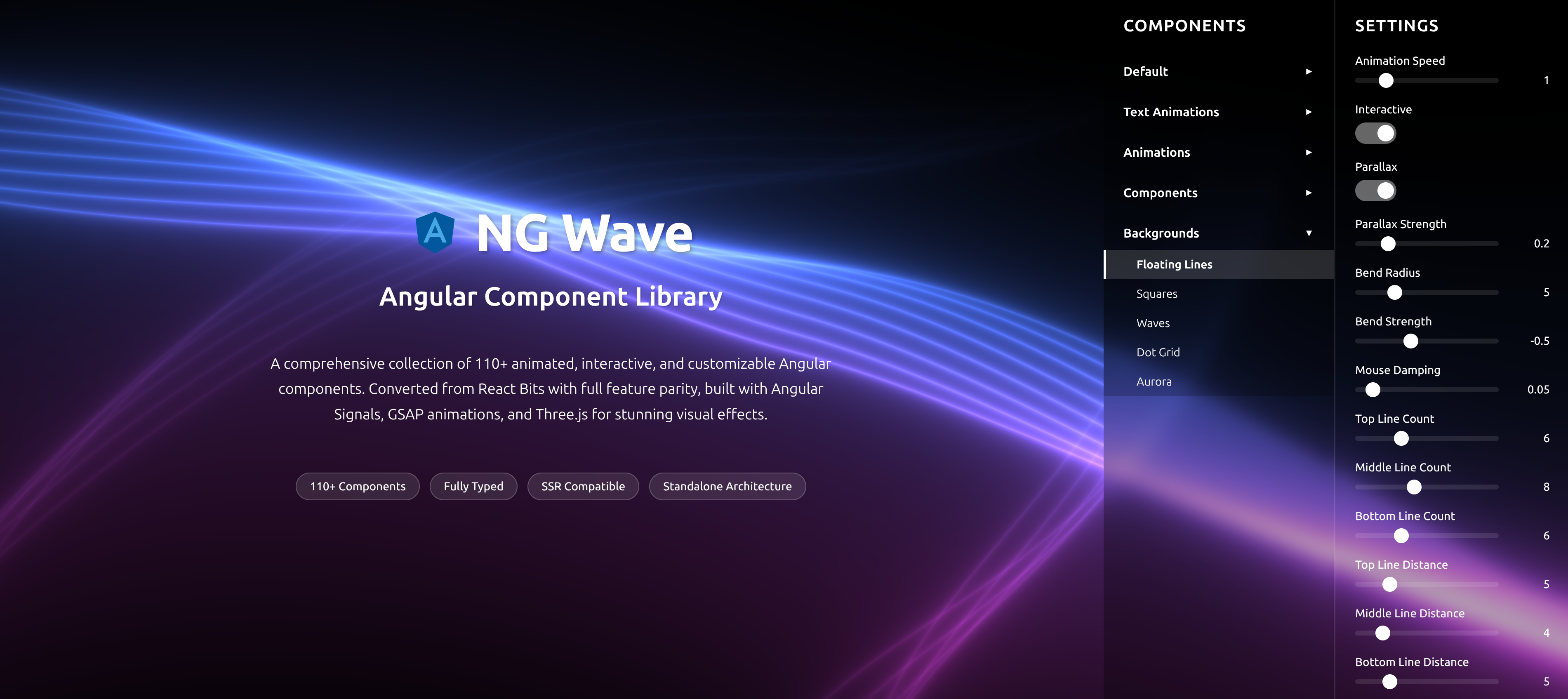
NG Wave
Angular Component Library
A comprehensive collection of 110+ animated, interactive, and customizable Angular components. Converted from React Bits with full feature parity, built with Angular Signals, GSAP animations, and Three.js for stunning visual effects.
Explore Components