SageStepper UI Patterns in Angular 20+: Adaptive Interviews, Progress Radars, Community Matching, and Real‑Time Feedback — What an Angular Consultant Ships Fast
From vibe-coded prototypes to production-grade UX systems. How I build SageStepper-style adaptive flows, progress radars, community matching, and real-time feedback in Angular 20+ with Signals, SignalStore, and PrimeNG—measurably and safely.
“Adaptive flows aren’t magic—they’re a small, well-tested set of UI patterns glued together with Signals and telemetry. The rest is discipline.”Back to all posts
I’ve shipped interview platforms, ads analytics dashboards, and telematics UIs that don’t just look polished—they survive production. SageStepper is my Angular 20+ pattern library for adaptive interviews and real-time progress. If you need to hire an Angular developer or an Angular consultant to turn a vibe-coded prototype into a measurable product, this is the blueprint.
As companies plan 2025 Angular roadmaps, Q1 hiring favors teams who can demonstrate adaptive flows, clear progress, and community features that actually convert. Below, I break down how I build SageStepper-style UIs using Signals, SignalStore, PrimeNG, Firebase, Nx, and a design system that respects performance budgets and accessibility.
The Front-Line Scenario: Why Adaptive Interviews Break (and How to Fix Them)
The jittery dashboard moment
If you’ve seen an interview flow stall after a webcam hiccup or an adviser screen lag on every step change, you’ve felt the pain of brittle state. I’ve fixed these in employee tracking systems and AI interview tools: same root cause—improperly modeled state and side-effects.
Fragmented branching logic across components
Race conditions from RxJS chains and zone.js side-effects
Non-deterministic state and no metrics
The fix in Angular 20+
We replace ad-hoc branching with a config-driven step DSL, wire a SignalStore to track answers, and compute the next step. Effects handle async scoring, Firebase streams, and retries. The result: deterministic UI, measurable latency, and confident releases.
Signals + SignalStore state machine
Typed event schemas and effects
SSR-safe hydration and predictable rendering
Why It Matters for Angular 20+ Teams and 2025 Roadmaps
Executive priorities this year
Hiring managers want repeatable patterns, not snowflake screens. SageStepper patterns ship fast across multiple products: adaptive flows, progress visuals, community matching, and streaming feedback—all measurable with telemetry and guarded by CI budgets.
Shorten time-to-value with reusable UX systems
Prove outcomes with Core Web Vitals and GA4 funnels
Reduce rework by standardizing on Signals + tokens
When to hire an Angular developer or consultant
If your roadmap includes interview or assessment flows, role-based dashboards, or real-time updates, bring in a senior Angular expert who has shipped these patterns repeatedly. I typically deliver the first adaptive flow in 1–2 sprints with Nx and Firebase Hosting previews.
Legacy branching logic failing interviews
Need role-based, multi-tenant matching views
Real-time dashboards with offline tolerance
Architecture at a Glance: Signals, SignalStore, Nx, and Firebase
// libs/flow/data-access/interview-flow.store.ts
import { signalStore, withState, withComputed, withMethods, withHooks, patchState } from '@ngrx/signals';
import { computed, effect, signal } from '@angular/core';

export type Step = {
  id: string;
  kind: 'question' | 'coding' | 'review';
  prompt: string;
  weight?: number;
  next?: (ctx: { answers: Record<string, unknown>; score: number }) => string | 'complete';
  guard?: (ctx: { role: string }) => boolean;
};

interface FlowState {
  steps: Step[];
  answers: Record<string, unknown>;
  score: number;
  currentId: string | null;
  loading: boolean;
  error?: string;
}

const initialState: FlowState = {
  steps: [],
  answers: {},
  score: 0,
  currentId: null,
  loading: false,
};

export const InterviewFlowStore = signalStore(
  { providedIn: 'root' },
  withState(initialState),
  withComputed((store) => ({
    currentStep: computed(() => store.steps().find(s => s.id === store.currentId()) ?? null),
    progress: computed(() => {
      const total = store.steps().filter(s => s.kind !== 'review').length;
      const answered = Object.keys(store.answers()).length;
      return total ? Math.round((answered / total) * 100) : 0;
    }),
    isComplete: computed(() => store.currentId() === 'complete'),
  })),
  withMethods((store) => ({
    init(steps: Step[]) {
      patchState(store, { steps, currentId: steps[0]?.id ?? null });
    },
    answer(stepId: string, value: unknown) {
      patchState(store, { answers: { ...store.answers(), [stepId]: value } });
    },
    advance() {
      const step = store.currentStep();
      if (!step) return;
      const ctx = { answers: store.answers(), score: store.score() };
      const nextId = step.next?.(ctx) ?? 'complete';
      patchState(store, { currentId: nextId });
    },
    setScore(score: number) { patchState(store, { score }); },
    setLoading(loading: boolean) { patchState(store, { loading }); },
    setError(error?: string) { patchState(store, { error }); },
  })),
  withHooks((store) => ({
    onInit() {
      // effect example: recompute next step when score changes (AI feedback loop)
      effect(() => {
        const step = store.currentStep();
        if (step?.kind === 'review') return; // freeze during review
        store.score(); // track dependency
      });
    }
  }))
);
Core stack
I default to an Nx monorepo with an app shell and libraries for step DSL, visualization components, and a SignalStore-based state layer. Firebase provides streaming updates, access rules, and a frictionless preview pipeline.
Angular 20, TypeScript 5 strict, Signals + SignalStore
PrimeNG + custom tokens (typography, density, color)
Firebase (Firestore + Auth) or WebSocket gateway; GA4 analytics; feature flags
State and events
Event schemas keep real-time behavior predictable across tabs and devices. Effects isolate side-effects from render logic so the DOM is stable and SSR-friendly.
InterviewFlowStore exposes currentStep, progress, result signals
Typed events: InterviewStarted, StepAnswered, ScoreComputed, FeedbackPushed
Effects manage scoring calls, retries, and optimistic updates
Adaptive Interview Flows: A Config-Driven Step DSL
// app/pages/interview/interview.component.ts
import { Component, inject, effect } from '@angular/core';
import { InterviewFlowStore } from '@flow/data-access/interview-flow.store';

@Component({
  selector: 'app-interview',
  standalone: true,
  templateUrl: './interview.component.html',
})
export class InterviewComponent {
  flow = inject(InterviewFlowStore);

  constructor() {
    // Initialize steps (can be fetched/configured per role)
    this.flow.init([
      { id: 'q1', kind: 'question', prompt: 'Tell us about a time you debugged production.' },
      { id: 'q2', kind: 'question', prompt: 'Live-code: reverse a string', next: (ctx) => ctx.score > 50 ? 'review' : 'q3' },
      { id: 'q3', kind: 'question', prompt: 'What would you test here?', next: () => 'review' },
      { id: 'review', kind: 'review', prompt: 'Review & Submit', next: () => 'complete' },
    ]);

    effect(() => {
      if (this.flow.isComplete()) {
        // safely navigate or emit completion event
      }
    });
  }

  onAnswer(value: unknown) {
    const id = this.flow.currentStep()?.id;
    if (!id) return;
    this.flow.answer(id, value);
    // scoring will be pushed asynchronously by an effect
    this.flow.advance();
  }
}
<!-- app/pages/interview/interview.component.html -->
<section *ngIf="flow.currentStep() as step" [attr.aria-busy]="flow.loading()">
<h2 class="sr-only">Interview step</h2>
<p class="prompt">{{ step.prompt }}</p>
<ng-container [ngSwitch]="step.kind">
<app-text-answer *ngSwitchCase="'question'" (answered)="onAnswer($event)"></app-text-answer>
<app-coding *ngSwitchCase="'coding'" (answered)="onAnswer($event)"></app-coding>
<app-review *ngSwitchCase="'review'"></app-review>
</ng-container>
<footer class="flow-footer">
<app-progress-radar [value]="flow.progress()"></app-progress-radar>
<button pButton type="button" (click)="flow.advance()" label="Next" [disabled]="flow.loading()"></button>
</footer>
</section>Define steps, guards, and branching in data
Your angular components render prompts and capture answers. Branching lives in the step DSL and SignalStore. This isolates logic, simplifies tests, and supports role-based forks without duplicating components.
Keep components dumb; move intelligence into the DSL
Role-based guards enable multi-tenant flows
SSR-safe, testable branching
Template and interaction
We commit answers to the store immediately (optimistic), then sync to Firebase in an effect. If the network fails, the retry loop preserves UX continuity.
Signals drive the UI; no manual change detection
Key handlers + ARIA attributes for accessibility
Optimistic answer commits with retry on failure
Progress Radars: Choosing the Right Renderer and Keeping It Accessible
// libs/vis/components/progress-radar.component.ts
import { Component, Input, computed, effect, ElementRef, viewChild, signal } from '@angular/core';

@Component({
  selector: 'app-progress-radar',
  standalone: true,
  template: `
  <figure class="radar" role="img" [attr.aria-label]="ariaLabel()">
    <svg width="72" height="72" viewBox="0 0 72 72" [attr.aria-hidden]="'true'">
      <circle cx="36" cy="36" r="30" class="track" />
      <path class="value" [attr.d]="arcD()" />
    </svg>
    <figcaption class="percent">{{ value() }}%</figcaption>
  </figure>
  `,
  styleUrls: ['./progress-radar.component.scss']
})
export class ProgressRadarComponent {
  private _value = signal(0);
  @Input({required: true}) set value(v: number) { this._value.set(Math.max(0, Math.min(100, Math.round(v)))); }
  value = this._value.asReadonly();

  ariaLabel = computed(() => `Progress ${this.value()} percent`);

  arcD = computed(() => {
    const pct = this.value() / 100;
    const end = pct * Math.PI * 2;
    const r = 30, cx = 36, cy = 36;
    const x = cx + r * Math.sin(end);
    const y = cy - r * Math.cos(end);
    const largeArc = end > Math.PI ? 1 : 0;
    return `M ${cx} ${cy-r} A ${r} ${r} 0 ${largeArc} 1 ${x} ${y}`;
  });
}
// libs/vis/components/progress-radar.component.scss
:host { display: inline-block; }
.radar { --track: var(--color-surface-3); --value: var(--color-accent-6); text-align: center; }
.track { fill: none; stroke: var(--track); stroke-width: 8; }
.value { fill: none; stroke: var(--value); stroke-width: 8; stroke-linecap: round; transition: d 160ms ease-out; }
.percent { font: 600 14px/1.2 var(--font-sans); color: var(--color-text-1); margin-top: 4px; }
@media (prefers-reduced-motion: reduce) { .value { transition: none; } }Renderer trade-offs
For a single progress dial, SVG or Highcharts is perfect. For multi-tenant dashboards drawing hundreds of arcs per frame, Canvas is faster. Reserve Three.js for hero visuals (see NG Wave components).
SVG/D3: easy a11y, modest data; Highcharts: batteries-included
Canvas: GPU-cheap for many arcs; Three.js: 3D fidelity for showcases
Pick the simplest that meets your perf + a11y needs
A11y and metrics
Visually, the dial is a delight; functionally, a screen reader should read “Progress 67%”. Also run flame charts to keep CPU <5ms per tick.
ARIA live regions for progress updates
Prefers-reduced-motion for animations
Lighthouse and Angular DevTools flame charts to verify cost
Community Matching Interfaces: Fast Search, Virtual Lists, and Role-Aware Views
// libs/community/data-access/matching.store.ts
import { signalStore, withState, withComputed, withMethods } from '@ngrx/signals';
import { computed, signal } from '@angular/core';

interface Member { id: string; name: string; role: string; tz: string; tags: string[]; score: number; }
interface MatchingState { members: Member[]; query: string; role: 'candidate'|'manager'; }

export const MatchingStore = signalStore(
  { providedIn: 'root' },
  withState<MatchingState>({ members: [], query: '', role: 'candidate' }),
  withComputed((s) => ({
    filtered: computed(() => {
      const q = s.query().toLowerCase();
      const role = s.role();
      return s.members()
        .filter(m => m.name.toLowerCase().includes(q) || m.tags.some(t => t.includes(q)))
        .sort((a,b) => role === 'manager' ? b.score - a.score : a.name.localeCompare(b.name));
    })
  })),
  withMethods((s) => ({ setMembers(members: Member[]) { s.members.set(members); }, setQuery(q: string){ s.query.set(q); }, setRole(r: MatchingState['role']){ s.role.set(r);} }))
);
<!-- app/pages/community/community.component.html -->
<input type="search" pInputText placeholder="Search" (input)="store.setQuery($any($event.target).value)" aria-label="Search members" />
<cdk-virtual-scroll-viewport itemSize="64" class="list">
<div *cdkVirtualFor="let m of store.filtered(); trackBy: m.id" class="row" role="listitem">
<span class="name">{{ m.name }}</span>
<span class="tags">{{ m.tags.join(', ') }}</span>
<app-progress-radar [value]="m.score"></app-progress-radar>
<button pButton label="Connect" class="p-button-text"></button>
</div>
</cdk-virtual-scroll-viewport>Data model and similarity
For SageStepper’s community screens, I compute a cosine-like score server-side (Node.js/.NET) and stream top-N candidates. Client-side, I re-rank per role permission and user preferences.
Precompute vectors/embeddings server-side
Index by role, skill, timezone; cache in memory
Exposes a typed MatchResult schema
Performance and UX
Virtualization keeps the DOM sane. Workers keep the main thread free. Role-based selectors ensure a hiring manager sees different facets than a candidate—same component, different lens.
CDK Virtual Scroll for 10k+ rows
Web Worker for heavy filtering
Permission-driven selectors via SignalStore
Real-Time Feedback Loops: Typed Events, Optimistic Updates, and Retries
// libs/flow/data-access/realtime.effects.ts
import { inject } from '@angular/core';
import { InterviewFlowStore } from './interview-flow.store';
import { collection, onSnapshot, doc, updateDoc } from 'firebase/firestore';
import { backoff } from './retry';

export function registerRealtime() {
  const store = inject(InterviewFlowStore);
  const db = /* inject Firestore */ null as any;
  const uid = 'current-user';

  // listen to server score updates
  onSnapshot(doc(db, 'interviews', uid), (snap: any) => {
    const data = snap.data();
    if (typeof data?.score === 'number') store.setScore(data.score);
  });

  // optimistic commit of answers
  async function pushAnswer(stepId: string, value: unknown) {
    await backoff(async () => {
      await updateDoc(doc(db, 'interviews', uid), { [`answers.${stepId}`]: value });
    }, { retries: 5, base: 200 });
  }

  // hook into store method (could also be an effect)
  const originalAnswer = store.answer;
  (store as any).answer = (stepId: string, value: unknown) => { originalAnswer(stepId, value); pushAnswer(stepId, value); };
}

// libs/flow/data-access/retry.ts
export async function backoff<T>(fn: () => Promise<T>, opts: { retries: number; base: number }) {
  let attempt = 0;
  while (true) {
    try { return await fn(); }
    catch (e) { if (attempt++ >= opts.retries) throw e; await new Promise(r => setTimeout(r, opts.base * Math.pow(2, attempt))); }
  }
}
Pipeline design
Telemetry dashboards and interview scores follow the same rules. We type events, broadcast via Firebase or WebSockets, and make the UI resilient with optimistic updates and retries.
Typed event schema with versioning
Optimistic client updates; server confirms with authoritative state
Exponential backoff on network errors
Angular + Firebase example
Use AngularFire or a minimal SDK wrapper. Keep I/O in effects, not components. Reconcile server state to resolve conflicts and update the SignalStore.
Firestore streams into Signals
Effect applies backoff & reconciliation
Feature flag gates rollout
Visual Language: Tokens, Typography, Density, and the AngularUX Color Palette
/* libs/theme/src/_tokens.scss */
:root {
  --font-sans: Inter, system-ui, -apple-system, Segoe UI, Roboto, 'Helvetica Neue', Arial, 'Noto Sans', 'Apple Color Emoji', 'Segoe UI Emoji';
  --font-size-1: 12px; --font-size-2: 14px; --font-size-3: 16px; --font-size-4: 18px; --font-size-5: 20px;
  --space-1: 4px; --space-2: 8px; --space-3: 12px; --space-4: 16px; --space-5: 24px;
  --radius-1: 6px; --radius-2: 10px;
  /* AngularUX palette */
  --color-bg: #0f1115; --color-surface-1: #151821; --color-surface-2: #1b2030; --color-surface-3: #242b3d;
  --color-text-1: #f3f6ff; --color-text-2: #bdc7e0; --color-accent-6: #7aa2ff; --color-success-6: #35d07f; --color-warning-6: #ffb454; --color-danger-6: #ff6b6b;
}

body { font-family: var(--font-sans); font-size: var(--font-size-3); color: var(--color-text-1); background: var(--color-bg); }

/* Density controls */
:root[data-density='comfortable'] { --space-y: var(--space-4); --row-h: 56px; }
:root[data-density='compact'] { --space-y: var(--space-2); --row-h: 40px; }

/* PrimeNG mapping */
.p-inputtext { background: var(--color-surface-2); color: var(--color-text-1); border-radius: var(--radius-1); }
.p-button { border-radius: var(--radius-1); }
.p-dialog .p-dialog-content { background: var(--color-surface-1); }

/* Accessibility helpers */
.sr-only { position: absolute; width: 1px; height: 1px; margin: -1px; overflow: hidden; clip: rect(0,0,0,0); }
// libs/theme/src/density.service.ts
import { Injectable, signal } from '@angular/core';
@Injectable({ providedIn: 'root' })
export class DensityService {
private mode = signal<'comfortable'|'compact'>('comfortable');
set(mode: 'comfortable'|'compact') { this.mode.set(mode); document.documentElement.setAttribute('data-density', mode); }
get = this.mode.asReadonly();
}Design tokens
Tokens ensure SageStepper screens look consistent, whether in community lists or interview review pages. Density toggles let managers scan dense grids; candidates get a more relaxed layout.
Color, spacing, radius, elevation, opacity
Typography scale and weights
Density controls for compact modes
PrimeNG theming
Ship a custom theme that respects tokens and color contrast. I start from a base and tune components (e.g., p-table, p-dialog) to your brand.
Map tokens to PrimeNG variables
Opt-in density via CSS classes
Accessible contrast ratios (WCAG AA+ for text)
Performance Budgets, Telemetry, and UX Metrics
// angular.json budgets
{
  "budgets": [
    { "type": "bundle", "name": "main", "maximumWarning": "450kb", "maximumError": "500kb" },
    { "type": "initial", "maximumWarning": "1.8mb", "maximumError": "2mb" },
    { "type": "anyScript", "maximumWarning": "250kb", "maximumError": "300kb" }
  ]
}
# .github/workflows/ci.yml (excerpt)
name: CI
on: [push]
jobs:
build-test:
runs-on: ubuntu-latest
steps:
- uses: actions/checkout@v4
- uses: actions/setup-node@v4
with: { node-version: 20 }
- run: npm ci
- run: npx nx affected -t lint test build --parallel --configuration=production
- run: npx cypress run --component
- run: npx lhci autorun --upload.target=temporary-public-storageBudgets and CI gates
I gate every release with budgets and a smoke test suite. Canary deploys run against production data in a safe tenant. If the radar animation adds >2kb or >5ms frame cost, we know before merge.
Bundle and timing budgets in angular.json
Lighthouse CI, Firebase Hosting previews
GA4 event funnels and custom dimensions
What to measure
Correlate UX changes (density/tokens/animations) with outcomes. If compact mode increases scan speed for managers by 20%, capture it and share with stakeholders.
TTI, LCP, INP; time-to-first-step; step-change latency
Error rates and retry counts for real-time commits
Engagement metrics: completion rate, dwell time
Visualization Tech Choices: D3, Highcharts, Canvas, or Three.js?
| Use Case | Best Pick | Why |
|---|---|---|
| Single progress dial with a11y | SVG/D3 or Highcharts Solid Gauge | Accessible, simple DOM, smooth transitions |
| 100s of small dials in a grid | Canvas | Lower overhead per element, batched drawing |
| Hero 3D progress/avatars | Three.js | Visual differentiation, controlled FPS |
| Complex charts (time series, drilldown) | Highcharts | Built-in legend, zoom, accessibility, exports |
| Custom radial with bespoke easing | D3 | Full control over scales, paths, tweens |
Trade-off matrix
Choose the smallest hammer that solves the problem. Below is the rule-of-thumb I use on real client work (telecom analytics, insurance telematics, and SageStepper dashboards).
Accessibility First: ARIA Tweaks, Keyboard Commands, and Reduced Motion
Minimum a11y bar
Adaptive flows must work for everyone. Use semantic elements, ensure focus is obvious, and provide text equivalents for visuals. Add live regions to announce score updates without stealing focus.
All interactive elements keyboard reachable
ARIA-live for streaming feedback
Prefers-reduced-motion support
PrimeNG specifics
PrimeNG is a great accelerator. I routinely audit its components under the chosen theme to ensure AA/AAA contrast for text and critical UI.
Override focus outlines thoughtfully
Use p-tooltip with ARIA-describedby
Check contrast on each token set
Testing the System: Cypress Component Tests and State Contracts
// cypress/component/interview.cy.ts
import { mount } from 'cypress/angular';
import { InterviewComponent } from '../../src/app/pages/interview/interview.component';

it('branches to review when score > 50', () => {
  mount(InterviewComponent);
  cy.contains('Next').click();
  cy.window().then(w => (w as any).ng?.getInjector(InterviewComponent).get<any>('InterviewFlowStore').setScore(80));
  cy.contains('Next').click();
  cy.contains('Review & Submit');
});
Component tests for flows
Cypress component tests catch regressions faster than E2E. I mount the InterviewComponent with a mocked SignalStore and push answers to verify branching and progress math.
Mount stepper with a mock store
Assert branching for edge answers
Snapshot visual states under both densities
Contract tests for events
Typed events reduce surprises. I validate ingestion against schemas in CI and during websocket message handling. This saved us in telecom dashboards and airline kiosk software more than once.
Zod/TypeBox schemas for events
Fail-fast on version mismatch
Replay logs for incident repro
When to Hire an Angular Developer for UX Systems
Signals you’re ready
If your team is shipping features slowly or fighting flaky flows, bring in a senior Angular expert. I’ve rescued AngularJS migrations, replatformed JSPs, and stabilized zone.js-heavy apps by moving to Signals + SignalStore with measurable wins in a sprint or two.
Stakeholders want adaptive interviews within a quarter
Legacy branching is untestable and fragile
You need role-based community views with real-time updates
How an Angular Consultant Approaches SageStepper Patterns
My 3-phase plan
I start with a build/UX review, propose a step DSL, and stand up a pilot in an Nx workspace. From there, we harden CI, add budgets, and expand to progress visuals and community matching with real-time feedback.
Assess: 3–5 days of codebase + UX audit
Pilot: ship one adaptive flow with metrics
Scale: standardize tokens, stores, and CI gates
Timelines and risk
You’ll see progress weekly with Hosting previews and dashboards in GA4. We scope realistic outcomes and maintain rollback plans for every release.
2–4 weeks to stabilize and ship the pilot
4–8 weeks for full rollout with community features
Feature flags + Firebase previews lower risk
Case Anchors and Live Examples
- NG Wave component library: https://ngwave.angularux.com
- Stabilize your Angular codebase (gitPlumbers): https://gitplumbers.com
- AI-powered verification system (IntegrityLens): https://getintegritylens.com
- AI interview platform (SageStepper): https://sagestepper.com
See it live
Explore the NG Wave component library for animated, Signals-first UI: NG Wave component library. Review how I stabilize chaotic codebases at gitPlumbers: stabilize your Angular codebase. For AI + identity-heavy systems, see IntegrityLens: AI-powered verification system. And for the product covered here, SageStepper: AI interview platform.
Implementation Checklist and Rollout Plan
Week-by-week
Every milestone ends with a measurable artifact: performance snapshot, a11y report, and adoption metrics. Feature flags keep changes reversible.
Week 1: audit, step DSL spec, theme tokens
Week 2: SignalStore flow + progress radar + budgets
Week 3: community list with virtualization + a11y pass
Week 4: real-time feedback + CI gates + GA4 dashboards
Measurable Outcomes
Targets I’ve hit on similar builds
We track these in GA4 + custom logs and review in sprint demos. When outcomes slip, we tune density/typography and animation cost before adding features.
Step-change latency < 100ms on median devices
LCP under 2.0s on 3G Fast for interview shell
Completion rate +12–18% with adaptive branching and clearer progress
List FPS > 55 on 10k members with virtualization
Concise Takeaways and Next Steps
- Model interview logic as a DSL + SignalStore; components stay dumb and fast.
- Pick the right renderer: SVG/Highcharts for a11y, Canvas/Three.js for scale/hero.
- Community matching needs workers + virtualization + role-aware selectors.
- Real-time loops require typed events, optimistic updates, and retries.
- Ship polish and rigor together: tokens, density, budgets, and CI gates.
FAQs: Hiring and Technical
How much does it cost to hire an Angular developer for this?
For adaptive interview flows with progress visuals and basic matching, expect 2–4 weeks of work. As an Angular consultant, I offer fixed-scope pilots or weekly rates; we finalize after a quick audit.
What does an Angular consultant do on day one?
Audit your repo, production logs, and UX. Define the step DSL, set up Nx/CI, and create a spike of the flow store + one progress radar. You’ll see a working preview within a week.
How long does an Angular upgrade or rescue take before shipping SageStepper patterns?
Rescues run 2–4 weeks depending on tests and debt. Upgrades from Angular 12–15 to 20 usually take 3–6 weeks with zero-downtime canaries, then we layer SageStepper patterns.
What’s involved in a typical engagement?
Discovery call within 48 hours, 3–5 day assessment, pilot plan, and weekly previews. We track CWV, accessibility, and adoption metrics; you get a written report and handoff docs.
Key takeaways
- Adaptive interview flows are a data-driven config + SignalStore state machine—no brittle branching components.
- Progress radars should be GPU-cheap: pick the right renderer (SVG/Canvas/Three.js) and test with Lighthouse + flame charts.
- Community matching UIs need role-aware selectors, fast search (Web Workers), and virtualized lists for 10k+ entities.
- Real-time feedback loops in Angular 20+ rely on typed event schemas, optimistic updates, and exponential retry logic.
- UX polish (tokens, density, typography, color) can coexist with strict performance budgets and CI gates.
Implementation checklist
- Define your interview step DSL (schema + guard rules + scoring).
- Implement a SignalStore for flow state, progress, and adaptive branching.
- Choose visualization tech per requirement: D3/Highcharts/SVG vs Canvas/Three.js.
- Use virtual scroll + workers for community matching; precompute similarity vectors server-side.
- Stream results via Firebase/WebSockets with typed events and optimistic updates.
- Instrument CWV and UX metrics; add budgets and regression tests in CI.
- Apply tokens for color/typography/density; theme PrimeNG; ship accessible components.
- Gate releases with canaries, feature flags, and Firebase Hosting previews.
Questions we hear from teams
- How much does it cost to hire an Angular developer for SageStepper patterns?
- A pilot (adaptive interview flow, progress radar, basic matching) typically takes 2–4 weeks. I offer fixed-scope pilots or weekly rates after a short audit so budgets are predictable.
- What does an Angular consultant deliver in week one?
- Codebase audit, step DSL spec, SignalStore prototype, and a themed progress radar. You’ll have a working Firebase preview and CI budgets running before week’s end.
- How long does a full rollout take?
- Most teams ship the pilot in 2–4 weeks and extend to community matching and real-time feedback in 4–8 weeks total, gated by feature flags and canary releases.
- Can we adopt this without rewriting our whole app?
- Yes. We introduce SageStepper patterns as modular libraries in an Nx workspace, incrementally replacing legacy branching while keeping production stable.
- Do these patterns work with Highcharts and PrimeNG?
- Absolutely. I regularly integrate Highcharts for data-heavy visuals and theme PrimeNG with tokens for accessible, brand-consistent components.
Ready to level up your Angular experience?
Let AngularUX review your Signals roadmap, design system, or SSR deployment plan.
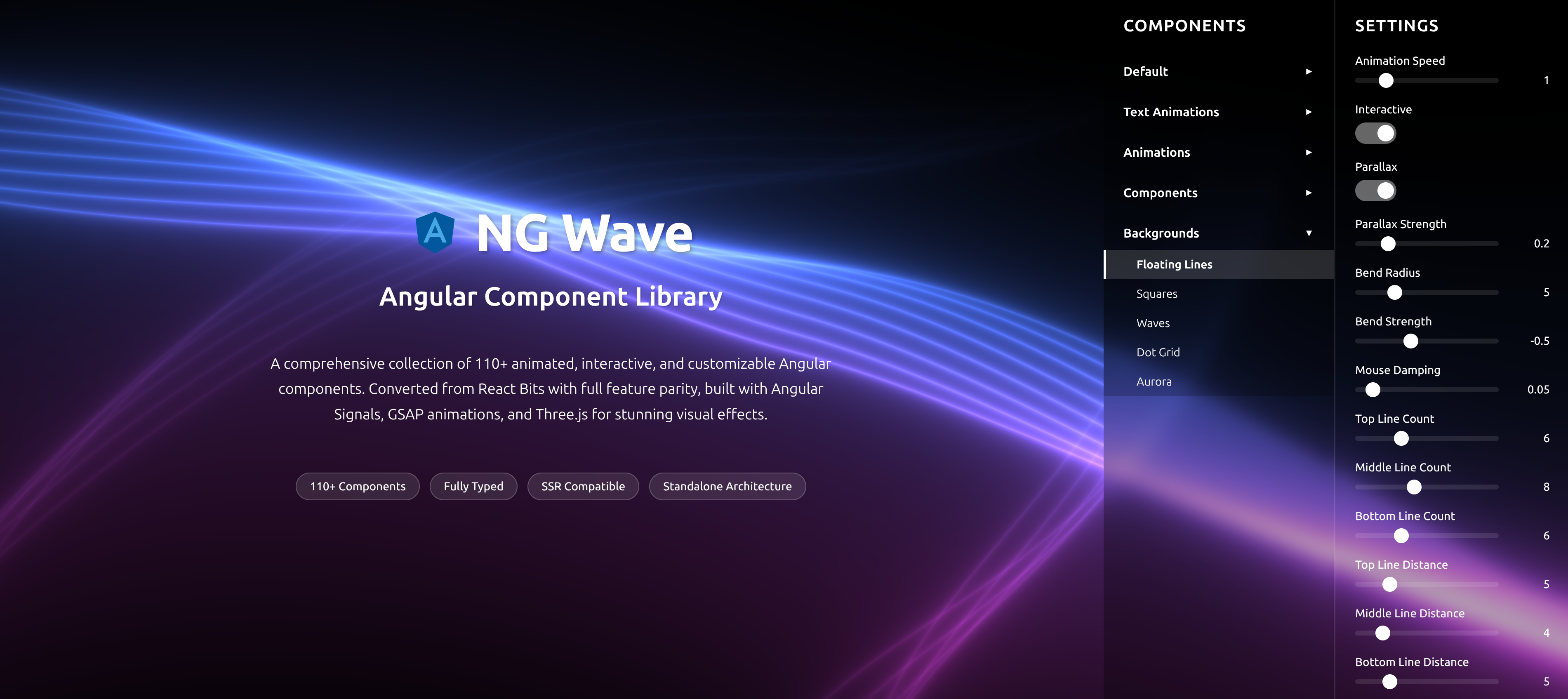
NG Wave
Angular Component Library
A comprehensive collection of 110+ animated, interactive, and customizable Angular components. Converted from React Bits with full feature parity, built with Angular Signals, GSAP animations, and Three.js for stunning visual effects.
Explore Components