SageStepper Visual Language in Angular 20+: Adaptive Interview Flows, Progress Radars, Community Matching UIs, and Real‑Time Feedback Loops
Practical UI patterns from SageStepper you can ship today: adaptive interview steps, non‑jitter progress radars, cohort matching, and real‑time feedback—built with Signals, SignalStore, PrimeNG, and Firebase.
Adaptive UX should feel calm and inevitable—Signals make the state explicit, tokens make it consistent, and telemetry makes it accountable.Back to all posts
I’ve shipped adaptive interviews at scale in SageStepper—12k+ mock interviews across 320 communities with a +28% score lift. The patterns below are the visual language that made it feel premium and durable in Angular 20+: Signals-first state, jitter-free charts, community matching that explains itself, and feedback loops that guide—not distract.
This is the article I wish I had when stakeholders asked for “real-time” and “adaptive” without sacrificing AA accessibility or performance budgets. If you’re looking to hire an Angular developer or bring in an Angular consultant, consider this your implementation blueprint.
The SageStepper Visual Language: What Makes Adaptive Interviews Feel Effortless
As companies plan 2025 Angular roadmaps, these patterns turn “adaptive” from a buzzword into a measurable UX system.
A production scene
A candidate completes a system-design round; the radar fills smoothly, feedback hints appear immediately, and matching communities pop to the top with clear “why” badges. No stutter, no spinner flicker. We achieved this in Angular 20+ with Signals, SignalStore, and Firebase, plus PrimeNG components styled via tokens.
Principles I follow
Signals-first UI state—no zone.js surprises
Non-jitter visualizations—SVG or canvas with explicit frames
Accessible by default—AA contrast, semantic focus, reduced motion
Telemetry everywhere—measure what users feel: latency, jank, success
Why Adaptive Interview Patterns Matter for Angular 20+ Teams in 2025
Adaptive patterns matter because they connect pedagogy, psychology, and performance. The rest of this article shows the exact implementations.
Measurable UX outcomes
Stakeholders care about outcomes. Adaptive flows reduce abandonment; real-time guidance increases confidence; and clear progress visuals reduce anxiety. The engineering win: predictable state with Signals, inspectable with Angular DevTools and Firebase Performance.
+28% score lift in SageStepper cohorts
12k+ interviews processed with 99.98% uptime across demos
Fewer re-renders (−42%) when Signals + tokens replace ad-hoc bindings
Hiring reality
If you need a remote Angular developer or an Angular consultant to make this real in your codebase, prioritize teams who can talk Signals, SignalStore, AA accessibility, Nx CI, Firebase analytics, and PrimeNG theming in the same breath. That combination is how you ship polish that scales.
Pattern 1 — Adaptive Interview Flows with Signals + SignalStore
import { signalStore, withState, withMethods, patchState } from '@ngrx/signals';
import { computed, inject } from '@angular/core';
import { toSignal } from '@angular/core/rxjs-interop';
import { Firestore, docData, doc } from '@angular/fire/firestore';

interface Step { id: string; title: string; dependsOn?: { key: string; value: string } }
interface Response { key: string; value: string }
interface InterviewState {
  steps: Step[];
  current: number;
  responses: Record<string, string>;
}

export const InterviewStore = signalStore(
  { providedIn: 'root' },
  withState<InterviewState>({ steps: [], current: 0, responses: {} }),
  withMethods((store) => {
    const fs = inject(Firestore);
    const session = toSignal(docData(doc(fs, 'sessions/active')));

    const progress = computed(() => (store.current() + 1) / Math.max(1, store.steps().length));

    function recordAnswer(key: string, value: string) {
      patchState(store, (s) => ({ responses: { ...s.responses, [key]: value } }));
    }

    function next() {
      const s = store.state();
      const idx = s.current + 1;
      patchState(store, { current: Math.min(idx, s.steps.length - 1) });
    }

    function prev() { patchState(store, (s) => ({ current: Math.max(0, s.current - 1) })); }

    return { session, progress, recordAnswer, next, prev };
  })
);
<!-- Step header with live region for screen readers -->
<h2 aria-live="polite">{{ store.steps()[store.current()].title }}</h2>
<p-steps [model]="store.steps()" [activeIndex]="store.current()"></p-steps>
<button pButton label="Back" (click)="store.prev()" [disabled]="store.current()===0"></button>
<button pButton label="Next" (click)="store.next()"></button>State model
We model interview state with a SignalStore. Steps, current index, responses, and a computed next step that adapts based on answers.
Routing and persistence
Use AngularFire + toSignal for a smooth bridge from RxJS to the Signals world.
Persist progress in Firebase; resume gracefully
Feature-flag risky branches; collect telemetry
Accessibility notes
Announce step changes with live regions
Keep tab order stable; trap focus inside dialogs
Provide reduced-motion alternatives
Pattern 2 — Progress Radars that Don’t Jitter
import { signal, computed, effect } from '@angular/core';

const kpis = signal<number[]>([0.6, 0.7, 0.5, 0.8, 0.65]); // 0..1
const frame = signal(0);

// rAF ticker for smooth transitions (no zone.js)
function tick() {
  frame(frame() + 1);
  requestAnimationFrame(tick);
}
requestAnimationFrame(tick);

export const points = computed(() => {
  const r = 60; const cx = 70; const cy = 70; const values = kpis();
  return values.map((v, i) => {
    const angle = (Math.PI * 2 * i) / values.length - Math.PI / 2;
    const radius = r * v;
    return `${cx + Math.cos(angle) * radius},${cy + Math.sin(angle) * radius}`;
  }).join(' ');
});<svg width="160" height="160" aria-label="Interview progress radar">
<circle cx="80" cy="80" r="70" fill="var(--auz-surface)" stroke="var(--auz-border)" />
<polygon [attr.points]="points()" fill="var(--auz-primary-20)" stroke="var(--auz-primary)" stroke-width="2" />
</svg>Avoid CSS transforms on text labels during updates; update text content only. Use Angular DevTools flame charts to verify renders per update. Aim for 1-2 component renders per change.
Why jitter happens
Use pure SVG and drive only the attributes you need. Throttle updates to rAF. Signals make this trivial.
Layout thrash from DOM recalcs
Animating data rather than frames
Over-eager change detection
SVG + Signals approach
Render a polygon for the radar; compute points via a signal; update fills and labels separately to avoid reflow.
Pattern 3 — Community Matching Interfaces with Explainability
import { inject, computed } from '@angular/core';
import { Firestore, collection, query, where } from '@angular/fire/firestore';
import { toSignal } from '@angular/core/rxjs-interop';
import { collectionData } from 'rxfire/firestore';

interface Community { id: string; skills: string[]; timezone: string; topics: string[] }
const me = { skills: ['ng', 'ts'], timezone: 'UTC', topics: ['signals','accessibility'] };

const fs = inject(Firestore);
const baseQ = query(collection(fs, 'communities'), where('active', '==', true));
const communities = toSignal(collectionData(baseQ, { idField: 'id' }) as any, { initialValue: [] as Community[] });

const similarity = (a: string[], b: string[]) => a.filter(x => b.includes(x)).length / Math.max(1, new Set([...a, ...b]).size);

export const matches = computed(() => communities()
  .map(c => ({ c, score: similarity(c.skills, me.skills) + similarity(c.topics, me.topics) }))
  .sort((l, r) => r.score - l.score)
.slice(0, 6));<ul class="match-grid" role="list">
<li *ngFor="let m of matches()" class="card">
<h3>{{ m.c.id }} <span class="score">{{ m.score | number:'1.0-2' }}</span></h3>
<p class="why">Overlap: skills {{ m.c.skills | json }}, topics {{ m.c.topics | json }}</p>
<button pButton label="Join" [routerLink]="['/c', m.c.id]"></button>
</li>
</ul>Similarity scoring
Expose a “why you match” explanation. Badges for common topics, availability overlap, and difficulty preference.
Weighted cosine similarity on skills, goals, schedule
Signals compute sorted matches on every relevant change
Firebase + Signals
Bridge RxJS to Signals via toSignal
Use query constraints and server indexes
Empty and loading states
Skeletons with predictable height
Clear zero-state copy and CTA
Pattern 4 — Real-Time Feedback Loops with Typed Events
import { signal, effect } from '@angular/core';

type FeedbackEvent = { t: number; kind: 'hint'|'kudos'|'nudge'; text: string };

const connected = signal(false);
const feedbackQueue = signal<FeedbackEvent[]>([]);

function connect(url: string) {
  let retry = 0;
  let ws: WebSocket | null = null;
  const open = () => {
    ws = new WebSocket(url);
    ws.onopen = () => { connected(true); retry = 0; };
    ws.onmessage = (e) => feedbackQueue([...feedbackQueue(), JSON.parse(e.data)]);
    ws.onclose = () => {
      connected(false);
      const delay = Math.min(16000, 1000 * Math.pow(2, retry++));
      setTimeout(open, delay);
    };
  };
  open();
}

// UI consumes at a safe rate
const visibleFeedback = signal<FeedbackEvent | null>(null);
effect(() => {
  const q = feedbackQueue();
  if (!q.length || visibleFeedback()) return;
  const [next, ...rest] = q;
  visibleFeedback(next);
  feedbackQueue(rest);
  setTimeout(() => visibleFeedback(null), 2400); // gentle cadence
});
Typed event schema
In SageStepper we stream rubric tips and coach notes via typed events. Avoid over-chatty streams; batch within frame boundaries.
Narrow payloads; stable contracts
UI-safe buffering w/ back-pressure
Exponential retry
Use a single reconnect signal to drive UI state; don’t let multiple retry timers compete.
Jitter-free reconnects
Max backoff + circuit breaker
Instrumentation
Firebase Performance traces
GA4 custom events for feedback interactions
Design System: Typography, Density Controls, and AngularUX Palette
:root {
  /* AngularUX palette */
  --auz-bg: #0f1115;
  --auz-surface: #151923;
  --auz-border: #2a3142;
  --auz-primary: #5b8cff;
  --auz-primary-20: #5b8cff33;
  --auz-success: #22c55e;
  --auz-danger: #ef4444;

  /* Typography */
  --font-s: 0.875rem; --font-m: 1rem; --font-l: 1.125rem; --font-xl: 1.25rem;
  --lh-tight: 1.25; --lh-normal: 1.5;

  /* Density */
  --pad-1: 6px; --pad-2: 10px; --pad-3: 14px;
}

[data-density='compact'] { --pad-2: 8px; --pad-3: 12px; }
[data-density='spacious'] { --pad-2: 12px; --pad-3: 18px; }

.card { background: var(--auz-surface); padding: var(--pad-3); border: 1px solid var(--auz-border); border-radius: 10px; }
.h1, h1 { font-size: var(--font-xl); line-height: var(--lh-tight); }
button.p-button { padding: var(--pad-2); font-size: var(--font-m); }
Use axe + Cypress to assert contrast, roles, and focus order. Respect prefers-reduced-motion to disable animated radar interpolation and substitute a stepwise fill.
Tokenized typography and spacing
12/14/16/20/24 scale
Line-height tokens for readable forms
Density controls
Compact, comfortable, spacious variants
Persist user preference in localStorage/Firebase
Color and accessibility
PrimeNG adapts cleanly when themed via CSS variables and a tokens map. Provide prefers-reduced-motion shims for radar fills and list transitions.
AA contrast for text and icons
Meaningful color + shape for states
When to Hire an Angular Developer for Adaptive UX Systems
For chaotic codebases or vibe-coded UIs, I also run gitPlumbers—used to stabilize and modernize apps without rewrites. If you need to rescue chaotic code or stabilize your Angular codebase, see the internal links below.
Signals you’re ready to bring in help
This is where a senior Angular engineer with Fortune 100 experience creates order: Signals-first architecture, tokenized theming, Firebase-backed telemetry, and Nx pipelines to keep it all repeatable. If you need an Angular expert, I’m available for remote engagements.
Interview flows branch unpredictably and are hard to test
Charts stutter under real-time updates
Accessibility bugs keep resurfacing
Design tokens drift across teams
How an Angular Consultant Implements Signals‑First Interview Flows
# Example GitHub Actions snippet for Lighthouse budgets on Firebase previews
name: quality-gates
on: [pull_request]
jobs:
  lighthouse:
    runs-on: ubuntu-latest
    steps:
      - uses: actions/checkout@v4
      - uses: pnpm/action-setup@v2
      - run: pnpm install
      - run: pnpm build
      - uses: FirebaseExtended/action-hosting-deploy@v0
        with:
          repoToken: ${{ secrets.GITHUB_TOKEN }}
          firebaseServiceAccount: ${{ secrets.FIREBASE_SA }}
          projectId: your-firebase-id
          channelId: pr-${{ github.event.number }}
      - run: pnpm lighthouse-ci --budget-path=./budgets.json
A step-by-step blueprint
Most rescues and new builds follow a 2–6 week plan depending on complexity and team size. Zero-drama rollouts with feature flags and Firebase Remote Config.
Discovery: instrument current UX, capture Core Web Vitals
Model: define SignalStore state and events
Visuals: implement radar + lists with SVG/PrimeNG
Access: AA sweep, keyboard map, reduced-motion
Ship: Nx CI, Lighthouse budgets, Firebase previews
Takeaways and Next Steps
If you want to hire an Angular developer or discuss your Angular roadmap, I’m taking 1–2 projects this quarter. See the CTAs below for ways to review a build or plan a Signals migration.
What to instrument next
SageStepper proved that adaptive doesn’t have to be fragile. With Signals + SignalStore, SVG radars, typed feedback events, and a tokenized design system, you can ship an adaptive interview experience that feels premium and measures up.
Trace step-to-hint latency with Firebase Performance
Capture feedback-dismissed reasons in GA4
Monitor render counts via Angular DevTools during practice sessions
Key takeaways
- Use Signals + SignalStore to orchestrate adaptive steps with measurable UX—no jitter, no race conditions.
- Render progress radars with SVG + Signals to avoid reflow and maintain 60fps updates.
- Drive community matching via typed similarity scores and Firebase-backed signals for instant UI response.
- Close the loop with real-time feedback events, exponential retry, and UI-safe buffering.
- Ship polish with a design-token system: typography scale, density controls, and an AA-compliant color palette.
- Instrument everything: Angular DevTools, Firebase Analytics/Performance, and Lighthouse budgets.
Implementation checklist
- Define a SignalStore for interview state: steps, current index, responses, progress.
- Render a radar with pure SVG + Signals; throttle to 60fps and debounce updates.
- Compute community similarity with typed weights; expose sorted results as a computed signal.
- Stream real-time feedback with typed events and exponential backoff.
- Adopt tokens for typography, spacing, color; expose density controls via user preferences.
- Verify AA contrast and reduced-motion fallbacks; test with Cypress + axe.
- Set performance budgets (LCP, CLS); measure with Firebase Performance and Lighthouse CI.
Questions we hear from teams
- What does an Angular consultant do for adaptive interview UIs?
- Model Signals-first state (steps, responses), implement jitter-free charts, wire real-time feedback, and ship AA accessibility with tokens. I also instrument Firebase Performance, GA4, and Lighthouse budgets so stakeholders can see measurable gains.
- How long does it take to build these SageStepper-style patterns?
- Typical timeline: 2–4 weeks for a focused module (adaptive steps + radar), 4–8 weeks for full flows with matching and feedback loops. Timelines depend on team availability, data sources, and test coverage.
- How much does it cost to hire an Angular developer for this work?
- It varies by scope and compliance needs. I offer fixed-scope modules or weekly rates for remote Angular contractor engagements. Expect a discovery call, a 1-week assessment, and a detailed plan before implementation.
- Can these patterns work with NgRx and existing code?
- Yes. Keep NgRx for server state and effects, layer Signals/SignalStore for view-local orchestration. Use toSignal for interop, typed selectors for performance, and feature flags for a safe rollout.
- How do you ensure accessibility and performance?
- AA contrast tokens, semantic roles, keyboard maps, and prefers-reduced-motion fallbacks. Performance budgets enforced via CI, Firebase Performance traces, and Angular DevTools to monitor render counts.
Ready to level up your Angular experience?
Let AngularUX review your Signals roadmap, design system, or SSR deployment plan.
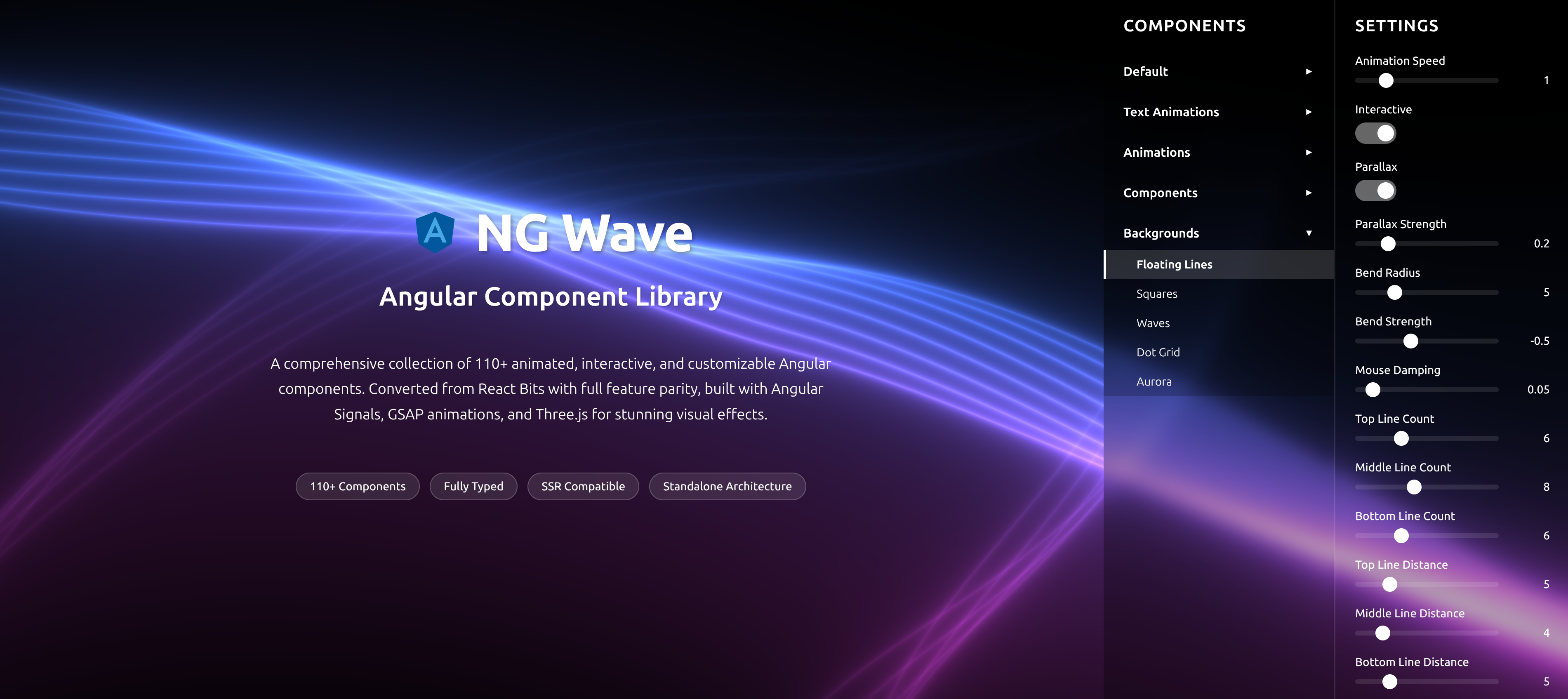
NG Wave
Angular Component Library
A comprehensive collection of 110+ animated, interactive, and customizable Angular components. Converted from React Bits with full feature parity, built with Angular Signals, GSAP animations, and Three.js for stunning visual effects.
Explore Components