Skimmable Technical UI in Angular 20+: highlight.js, Markdown, and Copy‑to‑Clipboard That Ship Fast and Accessible
How I design code‑heavy screens so engineers skim faster, copy safely, and stay in flow—without blowing performance budgets.
Skimmable technical UI is a feature, not a flourish. If the right snippet pops and copies cleanly, your users ship faster.Back to all posts
For the last decade, I’ve watched engineers bounce off docs and dashboards that bury the lede. In enterprise Angular 20+ apps—telecom analytics, airline kiosks, IoT portals—people skim. They need the command, the selector, the flag. This article shows the exact UX patterns I ship with highlight.js, Markdown, and copy-to-clipboard so technical readers move faster without breaking performance budgets.
These patterns live comfortably next to real-time dashboards (D3/Highcharts), Canvas/Three.js components, and role-based views. We’ll tie syntax colors into the AngularUX palette, respect accessibility, and wire analytics so you can prove they work.
Tooling-wise, we’ll stick to Angular 20+, Signals/SignalStore for theme and density, PrimeNG where useful, Nx for structure, and Firebase Analytics for instrumentation. If you’re looking to hire an Angular developer or Angular consultant to implement this in your app, this is the architecture I bring into Fortune 100 teams.
A Dashboard Team That Just Wants the Command
As companies plan 2025 Angular roadmaps, this is a small, high‑impact upgrade you can ship in days. I’ve applied it to employee tracking systems, IoT device portals, and airport kiosk admin consoles without disturbing core flows.
The moment that changed my docs UI
On a telecom analytics platform, release mornings were chaos. Engineers scanned long pages for a single curl, an ng add, or a feature flag. We standardized code fences, auto-highlight, and a clear copy button. Time-to-first-success dropped, and support pings fell off a cliff.
Why skimmability is a system
Skimmability isn’t decoration—it’s information scent. Use uniform code fences, callout badges, and density toggles so readers can visually parse in seconds.
Readers anchor on shapes: fenced blocks, badges, and headings.
Consistent patterns reduce cognitive load and bounce.
Copy buttons eliminate selection errors and whitespace surprises.
Why Angular Teams Need Skimmable Technical UI
This matters today because Angular 20+ teams are consolidating documentation into the app: role‑based dashboards with in‑context tips, admin consoles with flags, and code examples for power users. Skimmability keeps users in flow, reduces support, and pays for itself.
Impact you can measure
When you wire copy and expand events into Firebase Analytics, you can see whether the page is doing its job: faster copies, fewer backtracks, and higher task completion.
Copy events per session
Time-to-first-copy
Scroll depth to first code fence
CTA conversion after code interaction
Where it matters
Anywhere readers need a command or snippet, the trio of highlight.js + Markdown + copy-to-clipboard removes friction.
Release notes and migration guides
Feature flags and environment config
Data viz examples (D3/Highcharts) near metrics
Kiosk and offline workflows with device troubleshooting
How an Angular Consultant Implements highlight.js, Markdown, and Copy UX
Below is a trimmed setup I’ve used in Nx workspaces and PrimeNG-heavy apps. It’s SSR-safe, measurable, and doesn’t blow budgets.
Tree-shaken highlight.js
Only load the languages you need (ts, html, scss, bash, yaml, json). Using Angular’s dynamic imports keeps the docs module slim and fast.
Import core, lazy-load languages
Defer theme CSS
Guard with IntersectionObserver
Markdown that respects themes and density
Use Signals/SignalStore to flip themes without repaint chaos. Map theme tokens to syntax colors for legibility.
Signals store for theme and density
Tokens drive font sizes and spacing
Pre-render trusted content where possible
Accessible copy button
Copy is a first-class action: put the button where the eye lands, label it clearly, and announce success without stealing focus.
Keyboard first, visible focus
aria-live confirmation
Clipboard API with safe fallback
Code Walkthrough: Minimal Implementation
// docs-theme.store.ts (Angular 20+, SignalStore pattern)
import { signal, computed } from '@angular/core';

export type Density = 'compact' | 'comfortable';
export type Theme = 'light' | 'dark';

export class DocsThemeStore {
  readonly theme = signal<Theme>('light');
  readonly density = signal<Density>('comfortable');
  readonly codeFontSize = computed(() => this.density() === 'compact' ? '12px' : '13px');
}
// code-highlight.directive.ts
import { Directive, ElementRef, effect, inject } from '@angular/core';
import { DocsThemeStore } from './docs-theme.store';
@Directive({ selector: 'pre code[axHighlight]' })
export class CodeHighlightDirective {
private el = inject(ElementRef<HTMLElement>);
private store = inject(DocsThemeStore);
private observer?: IntersectionObserver;
private hljs: any;
constructor() {
// Re-highlight on theme changes
effect(() => {
const _ = this.store.theme();
this.tryHighlight();
});
}
async ngAfterViewInit() {
// Lazy-load only when visible
this.observer = new IntersectionObserver(async entries => {
if (entries.some(e => e.isIntersecting)) {
await this.loadHljs();
this.tryHighlight();
this.observer?.disconnect();
}
});
this.observer.observe(this.el.nativeElement);
}
private async loadHljs() {
if (this.hljs) return;
const hljs = await import('highlight.js/lib/core');
const ts = await import('highlight.js/lib/languages/typescript');
const html = await import('highlight.js/lib/languages/xml');
const scss = await import('highlight.js/lib/languages/scss');
const bash = await import('highlight.js/lib/languages/bash');
const yaml = await import('highlight.js/lib/languages/yaml');
const json = await import('highlight.js/lib/languages/json');
hljs.default.registerLanguage('typescript', ts.default);
hljs.default.registerLanguage('html', html.default);
hljs.default.registerLanguage('scss', scss.default);
hljs.default.registerLanguage('bash', bash.default);
hljs.default.registerLanguage('yaml', yaml.default);
hljs.default.registerLanguage('json', json.default);
this.hljs = hljs.default;
}
private tryHighlight() {
if (!this.hljs) return;
this.el.nativeElement.querySelectorAll('code').forEach(c => this.hljs.highlightElement(c as HTMLElement));
}
}// copy-button.component.ts (accessible copy with analytics)
import { Component, Input, signal } from '@angular/core';
import { getAnalytics, logEvent } from 'firebase/analytics';
@Component({
selector: 'ax-copy',
standalone: true,
template: `
<button
type="button"
class="ax-copy"
[attr.aria-label]="ariaLabel"
(click)="copy()"
>{{label}}</button>
<span class="sr-only" aria-live="polite">{{status()}}</span>
`,
})
export class CopyButtonComponent {
@Input() text = '';
@Input() label = 'Copy';
@Input() ariaLabel = 'Copy code to clipboard';
status = signal('');
async copy() {
try {
await navigator.clipboard.writeText(this.text);
this.status.set('Copied');
logEvent(getAnalytics(), 'copy_snippet', { length: this.text.length });
} catch {
const area = document.createElement('textarea');
area.value = this.text; document.body.appendChild(area); area.select();
document.execCommand('copy'); document.body.removeChild(area);
this.status.set('Copied');
logEvent(getAnalytics(), 'copy_snippet_fallback', {});
}
setTimeout(() => this.status.set(''), 2000);
}
}<!-- usage in a Markdown-rendered template -->
<div class="code-block" [attr.data-density]="store.density()">
<ax-copy [text]="codeSample"></ax-copy>
<pre><code axHighlight class="language-typescript">{{ codeSample }}</code></pre>
</div>/* tokens.scss — AngularUX palette + density */
:root {
--ax-ink: #0f172a; /* ink */
--ax-bg: #ffffff; /* surface */
--ax-accent: #c3002f; /* Angular-red accent */
--ax-muted: #64748b;
--ax-code-bg: #0b1020; /* dark panel for code */
--ax-code-ink: #e2e8f0; /* code text */
--ax-space-1: 4px; --ax-space-2: 8px; --ax-space-3: 12px;
}
[data-theme='dark'] {
--ax-bg: #0b1020; --ax-ink: #e2e8f0; --ax-code-bg: #0b1020; --ax-code-ink: #e2e8f0;
}
.code-block { background: var(--ax-code-bg); color: var(--ax-code-ink); border-radius: 6px; padding: var(--ax-space-2); }
.code-block[data-density='compact'] { padding: var(--ax-space-1); }
.ax-copy { background: var(--ax-accent); color: white; border: 0; border-radius: 4px; padding: 4px 8px; }
.ax-copy:focus-visible { outline: 2px solid #ffd166; outline-offset: 2px; }# nx.json or angular.json budgets excerpt (protect performance)
budgets:
- type: initial
maximumWarning: 200kb
maximumError: 350kb
- type: anyComponentStyle
maximumWarning: 8kb
maximumError: 12kbSignals for theme and density
Use a small store so both docs and dashboards can react instantly.
Directive for highlight.js
Lazy-load highlight.js, highlight when the block is visible, and re-run on theme change.
Copy button with analytics
Send a copy event to Firebase Analytics so PMs can see impact.
Visual Language: Typography, Density, and Color
I reuse the AngularUX palette across code fences, PrimeNG tables, and Highcharts labels so the app reads as one system. For Canvas/Three.js scenes and D3 overlays, I mirror the same tokens to keep legends and axes legible in both themes.
Typography that reads at speed
Technical readers parse shapes fast. Keep body copy neutral and let code command attention. Allow user control via density toggles backed by Signals.
Monospace for code: 12–13px compact, 14px comfortable
Body text: 14–16px, 1.5 line-height
Avoid all-caps labels for long phrases
Density controls for dashboards
In role-based dashboards, PMs want readability; engineers want density. A per-user SignalStore makes it trivial to toggle without layout jank.
Compact mode for engineers, comfortable for execs
Persist selection per user/tenant
Respect prefers-reduced-motion
Color tokens meet syntax themes
Tie highlight.js theme variables to your tokens so dark mode doesn’t destroy legibility. Keep accent consistent across links, CTAs, and selection.
Tokenize comments, strings, numbers, keywords
Ensure ≥ 4.5:1 contrast for code and inline badges
Use the same accent token for copy buttons and focus
Measure It: Instrumentation and UX Metrics
For Firebase projects, I’ll ship a GA4 dashboard showing copy events per session and average time-to-first-copy. On a broadcast media scheduler, this surfaced a 22% faster setup time after we standardized code fences.
Events to log
Log just enough to prove efficacy. Pair with Core Web Vitals and Lighthouse to ensure the embellishments didn’t regress performance.
copy_snippet, copy_snippet_fallback
code_fence_view (first exposure)
density_change, theme_change
expand_collapse for long snippets
Guardrails that keep you honest
I run visual diffs in Cypress for code blocks and badges. If a token change harms contrast, the build fails. That’s how UX polish coexists with engineering rigor.
CI bundle budgets for docs module
Visual regression on code blocks
Accessibility tests for contrast and focus
When to Hire an Angular Developer for Legacy Rescue
See how I stabilize chaotic apps and modernize docs UX at gitPlumbers (stabilize your Angular codebase) and explore component patterns in the NG Wave component library.
Symptoms I fix in 2–4 weeks
If your app has these symptoms, a focused UX systems sprint will reduce support churn fast without a feature freeze. I’ve done this for IoT device portals and accounting dashboards on tight deadlines.
Inconsistent code fences and no copy buttons
Unreadable dark mode syntax
Docs module inflates bundle by >200kb
No analytics linking docs to activation
Typical engagement
If you need a remote Angular developer or Angular consultant with Fortune 100 experience, I can parachute in, implement, and leave you with guardrails.
Discovery in 48 hours
Assessment in 1 week
Implementation 1–3 weeks
Enablement + handoff in final week
Putting It Next to Real-Time Dashboards
Whether it’s IntegrityLens (AI-powered verification system) or broadcast VPS scheduling, the same visual language helps technical readers act quickly under pressure.
Docs and data can live together
I pair these docs patterns with real-time panels: think telematics maps and ads analytics. Code fences sit beside metrics, and Signal-driven theme/density keeps both synchronized.
D3/Highcharts with data virtualization
WebSocket updates with typed event schemas
Exponential retry with jitter for resilience
Hardware and kiosks
In airport kiosk admin tools, code snippets explain recovery commands; copy buttons prevent typos when you’re on a tarmac Wi‑Fi.
Docker-based device simulation
Offline-tolerant flows and status banners
Peripheral APIs: card, printer, barcode
Concise Takeaways
- Treat code fences, badges, and copy buttons as a design system, not ad-hoc styling.
- Use Signals + tokens to keep theme/density instant and consistent across docs and dashboards.
- Protect budgets by lazy-loading highlight.js languages and deferring themes.
- Make copy accessible and measurable; log events to prove value.
- Verify contrast and focus in CI so polish never breaks accessibility.
Questions Teams Ask
If you’re ready to hire an Angular developer, I can drop into your repo, map the hot spots, and deliver a measurable upgrade without pausing feature work.
Will this bloat my bundle?
Not if you tree-shake highlight.js, load only needed languages, and keep a budget in CI. Expect <25–40kb extra for common stacks.
Do I need a docs CMS?
Often no. Markdown files in an Nx workspace with a small rendering module are enough for release notes and how-tos.
How fast can we ship this?
2–3 weeks for a robust, accessible implementation with analytics and CI guardrails in a typical enterprise app.
Key takeaways
- Code-heavy screens need a visual language: consistent code fences, badges, and copy buttons reduce cognitive load.
- Use highlight.js with tree-shaken languages and lazy themes to protect bundle budgets.
- Markdown + Angular Signals enables toggles for theme, density, and font size without jank.
- Accessible copy-to-clipboard: visible labels, aria-live confirmations, and keyboard-first focus order.
- Instrument copy and expand events with Firebase Analytics to prove ROI.
- Tie syntax colors to your design tokens so dark/light modes remain legible and on-brand.
Implementation checklist
- Define tokens for typography, spacing, and syntax colors before shipping docs UI.
- Load only the highlight.js languages you need; lazy-load themes.
- Offer copy buttons for every code fence with explicit labels and aria-live feedback.
- Provide density controls (compact/comfortable) for dashboard and docs panes.
- Measure copy events and time-on-task with Firebase Analytics or GA4.
- Validate color contrast for code, inline tokens, and badges in both themes.
Questions we hear from teams
- What does an Angular consultant do for docs and code UX?
- I standardize code fences, add accessible copy buttons, wire highlight.js with tokens, and instrument analytics. The result: faster onboarding, fewer tickets, and measurable UX wins.
- How long does it take to implement highlight.js + Markdown + copy UX?
- Most teams ship in 2–3 weeks, including accessibility and CI guardrails. Complex multi-tenant apps with dark mode and analytics usually fit into a 3–4 week sprint.
- Will highlight.js slow my Angular app?
- Not if you lazy-load languages, defer theme CSS, and set bundle budgets. I typically add 25–40kb for ts/html/scss/bash/yaml/json with no noticeable regressions.
- How much does it cost to hire an Angular developer for this work?
- Pricing depends on scope and timelines. Typical engagements run 2–4 weeks. Book a discovery call—I'll assess your repo and provide a fixed-price or time-boxed option.
- Can this live next to real-time dashboards and kiosks?
- Yes. I use Signals to sync theme/density across docs and dashboards. It plays well with D3/Highcharts, WebSockets, and offline-tolerant kiosk flows.
Ready to level up your Angular experience?
Let AngularUX review your Signals roadmap, design system, or SSR deployment plan.
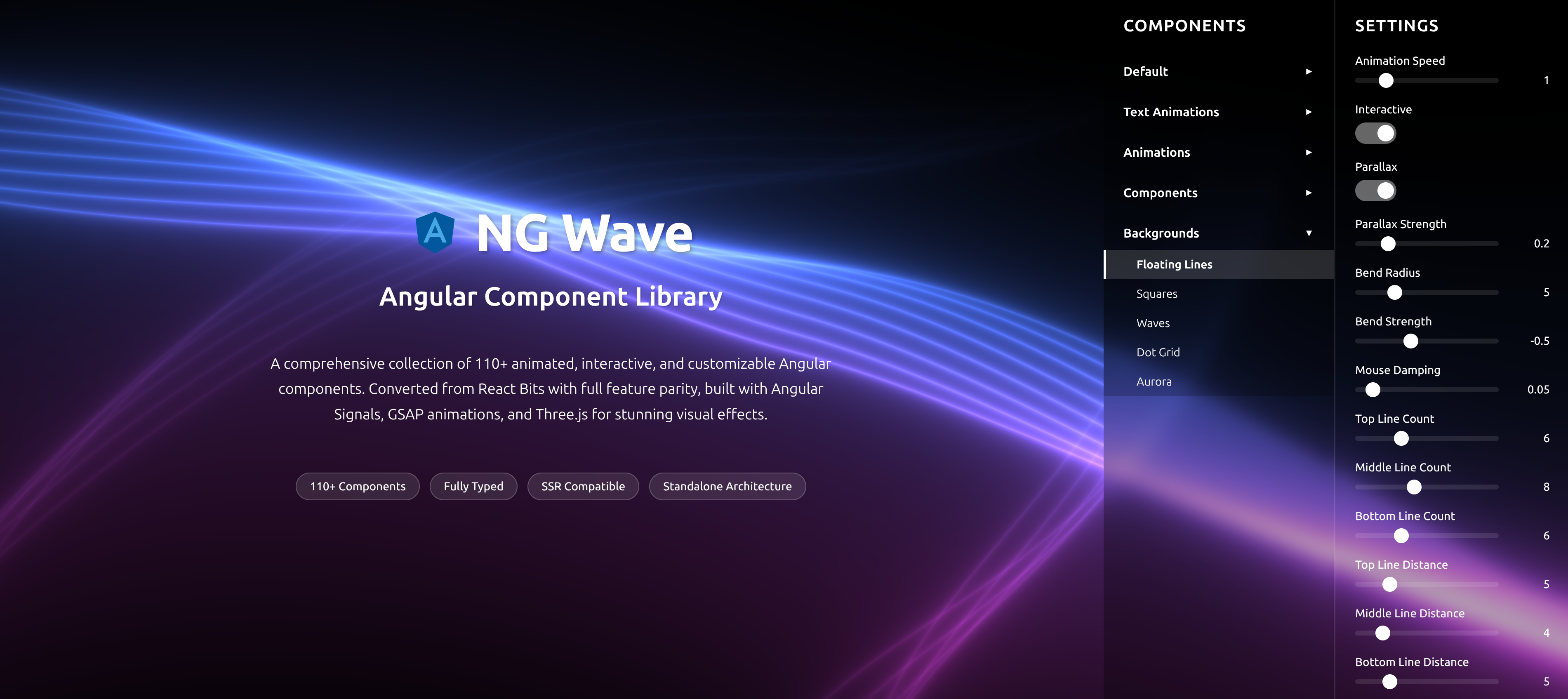
NG Wave
Angular Component Library
A comprehensive collection of 110+ animated, interactive, and customizable Angular components. Converted from React Bits with full feature parity, built with Angular Signals, GSAP animations, and Three.js for stunning visual effects.
Explore Components