Skimmable Technical UI in Angular 20+: highlight.js, Markdown, and Copy‑to‑Clipboard That Ship Fast and Accessible
Docs and dashboards that engineers skim in seconds: semantic Markdown, accessible code blocks, color‑coded syntax, and one‑tap copy—without blowing performance budgets.
Color-coded syntax and a trustworthy copy button turn a 30‑second read into a 5‑second skim.Back to all posts
I’ve shipped docs and dashboards where engineers decide in five seconds whether to stay or bounce. When the code blocks jitter, the colors are muddy, or the copy button fails, you lose trust. The fix isn’t complicated: semantic Markdown, highlight.js for crisp syntax, and copy-to-clipboard that works with screen readers—wired with Signals so it feels instant.
I’ve used this trio across a telecom advertising analytics portal (Angular 11→20 upgrade), an airline kiosk help system (offline-tolerant Markdown sheets), and an IoT device management dashboard. The pattern scales from internal docs to role-based dashboards with D3/Highcharts and data virtualization, and it fits cleanly into Angular 20+, Nx, PrimeNG, and Firebase.
Why Angular 20+ Docs and Dashboards Need Skimmable Technical UI
Real-world pressure
At a telecom client, analysts skimmed 20–40 code examples per day to build ad-segmentation queries. When syntax highlighting lagged or buttons shifted on layout reflow, INP spiked and trust dropped. In an airline kiosk, mechanics needed offline-readable steps with copyable commands—fatigue and gloves included.
Telemetry dashboards: 60fps scroll + readable code examples for API consumers
Kiosks: offline Markdown tips with big touch targets
Enterprise docs: role-based views where readers skim, not read
The UX trifecta
Together, these patterns compress time-to-understanding. You see headings, bullet steps, and colored tokens immediately, then copy without context switching. It’s fast, accessible, and auditable with Firebase Analytics. If you need a senior Angular consultant to wire this pattern into a design system, I’m available.
Markdown for structure
highlight.js for instant code parsing
Copy-to-clipboard for flow
The Architecture: Markdown, highlight.js, and CDK Clipboard in Angular 20+
Install and baseline
Use Nx for workspace hygiene and Firebase for previews/analytics. Install the essentials.
Install commands
npm i ngx-markdown highlight.js @angular/cdk @angular/cdk/clipboard dompurify
npm i -D @types/dompurify
Render Markdown safely
// app.config.ts
import { provideMarkdown } from 'ngx-markdown';
import DOMPurify from 'dompurify';

export const appConfig = {
  providers: [
    provideMarkdown({
      sanitize: (html: string) => DOMPurify.sanitize(html, { USE_PROFILES: { html: true } })
    })
  ]
};
<!-- doc-viewer.component.html -->
<markdown [data]="docMarkdown()" (ready)="highlightAll()"></markdown>// doc-viewer.component.ts
import { Component, signal, effect } from '@angular/core';
@Component({
selector: 'ux-doc-viewer',
templateUrl: './doc-viewer.component.html'
})
export class DocViewerComponent {
docMarkdown = signal<string>('');
async highlightAll() {
const [hljs] = await Promise.all([
import('highlight.js/lib/core'),
]);
// Lazy-register only the languages you show to keep bundles tight
const ts = await import('highlight.js/lib/languages/typescript');
hljs.default.registerLanguage('typescript', ts.default);
document.querySelectorAll('pre code').forEach(block => hljs.default.highlightElement(block as HTMLElement));
}
}SSR-friendly
Sanitized
Works with Signals
Accessible copy buttons with Signals
// copy.service.ts
import { Injectable, signal, effect } from '@angular/core';
import { Clipboard } from '@angular/cdk/clipboard';

@Injectable({ providedIn: 'root' })
export class CopyService {
  status = signal<'idle'|'copied'|'error'>('idle');
  constructor(private clipboard: Clipboard) {
    effect(() => {
      if (this.status() === 'copied') setTimeout(() => this.status.set('idle'), 1500);
    });
  }
  copy(text: string) {
    const ok = this.clipboard.copy(text);
    this.status.set(ok ? 'copied' : 'error');
  }
}
<!-- code-block.component.html -->
<div class="code-card" [class.compact]="density() === 'compact'">
<button
type="button"
class="copy-btn"
(click)="copy()"
aria-label="Copy code"
[attr.data-status]="status()"
>
{{ status() === 'copied' ? 'Copied' : 'Copy' }}
</button>
<pre><code #code><ng-content></ng-content></code></pre>
<span class="sr-only" aria-live="polite">
{{ status() === 'copied' ? 'Code copied to clipboard' : '' }}
</span>
</div>// code-block.component.ts
import { Component, ViewChild, ElementRef, inject, signal } from '@angular/core';
import { CopyService } from './copy.service';
@Component({ selector: 'ux-code-block', templateUrl: './code-block.component.html' })
export class CodeBlockComponent {
#copy = inject(CopyService);
@ViewChild('code', { static: true }) codeEl!: ElementRef<HTMLElement>;
status = this.#copy.status;
density = signal<'comfortable'|'compact'>('comfortable');
copy() {
this.#copy.copy(this.codeEl.nativeElement.innerText.trim());
}
}No jank (INP-safe)
A11y live region
Keyboard-friendly
PrimeNG + design-system fit
PrimeNG’s Panel or Card works well for framing code. Respect prefers-reduced-motion in the micro-animation that flips the copy icon to a checkmark.
Place copy buttons in a PrimeNG Toolbar
Use Elevation and tokens
Respect Reduced Motion
UX Systems: Typography, Density, and the AngularUX Color Palette
Readable code at a glance
/* tokens.scss */
:root {
  /* AngularUX palette */
  --ux-bg: #0f1115;
  --ux-surface: #161922;
  --ux-text: #e6e9ef;
  --ux-muted: #9aa4b2;
  --ux-accent: #5eead4;  /* teal */
  --ux-warn: #f59e0b;
  --ux-error: #ef4444;

  /* syntax tokens */
  --code-kw: #7aa2f7;
  --code-str: #9ece6a;
  --code-num: #ff9e64;
  --code-com: #63718b;

  /* typography */
  --font-code: ui-monospace, SFMono-Regular, Menlo, Consolas, 'Liberation Mono', monospace;
  --lh-code: 1.55;
  --fs-code: 0.95rem;

  /* density */
  --space-1: 0.25rem; --space-2: 0.5rem; --space-3: 0.75rem; --space-4: 1rem;
}

.code-card pre code {
  font-family: var(--font-code);
  font-size: var(--fs-code);
  line-height: var(--lh-code);
  color: var(--ux-text);
}
.code-card .hljs-keyword { color: var(--code-kw); }
.code-card .hljs-string  { color: var(--code-str); }
.code-card .hljs-number  { color: var(--code-num); }
.code-card .hljs-comment { color: var(--code-com); }

.code-card.compact pre { padding: var(--space-2); }
.code-card pre { padding: var(--space-4); background: var(--ux-surface); border-radius: 8px; }
.copy-btn { color: var(--ux-text); background: transparent; border: 1px solid var(--ux-muted); }
.copy-btn[data-status='copied'] { border-color: var(--ux-accent); color: var(--ux-accent); }
Typography and density tokens unify Markdown in docs with code examples in dashboards. The same tokens power components in the NG Wave component library so code, charts, and tables feel cohesive.
Monospace with generous line-height
Contrast ratios ≥ 4.5:1
Consistent token hues
Density controls at runtime
// ui.store.ts (SignalStore sketch)
import { signalStore, withState, withMethods } from '@ngrx/signals';

export interface UIState { density: 'comfortable'|'compact'; theme: 'dark'|'light'; }

export const UiStore = signalStore(
  withState<UIState>({ density: 'comfortable', theme: 'dark' }),
  withMethods((store) => ({ setDensity: (d: UIState['density']) => store.density.set(d) }))
);
Role-based dashboards can default density per role (analyst vs. exec). The store lets your code blocks and data tables switch spacing instantly without layout thrash.
Signal-driven density
Per-role defaults
Kiosk vs. desktop
Accessibility and Internationalization: Inclusive Code Blocks
Keyboard and screen reader support
Add an aria-label to copy buttons, keep tab order before the code content, and announce success through a polite live region. Include a visually hidden label with the language: “Copy TypeScript code”.
Focus ring and tab order
aria-live announcements
Label the language
Reduced motion and contrast
Skip icon morph animations when users prefer reduced motion. Ensure code token colors meet WCAG contrast.
Respect prefers-reduced-motion
High-contrast themes
i18n bits that matter
In an insurance telematics portal we localized Markdown tips and number formats; copy confirmations were translated via Angular i18n so support teams in LATAM copied the right code and felt at home.
Copy feedback strings via i18n
Localize numerals and dates inside Markdown
Performance and Measurement: Budgets, Lazy Highlighting, and Analytics
Lazy-load by language
Only register languages actually present on the page. For long docs, highlight on idle to keep INP stable.
Keep bundle small
Avoid blocking hydration
Track copy events with Firebase
// analytics.ts
import { inject } from '@angular/core';
import { Analytics, logEvent } from '@angular/fire/analytics';

export function trackCopy(lang: string, slug: string) {
  const analytics = inject(Analytics);
  logEvent(analytics, 'copy_code', { lang, slug });
}
Lighthouse + budgets in CI (Nx + GitHub Actions)
# .github/workflows/lhci.yml
name: lhci
on: [pull_request]
jobs:
  lhci:
    runs-on: ubuntu-latest
    steps:
      - uses: actions/checkout@v4
      - uses: actions/setup-node@v4
        with: { node-version: 20 }
      - run: npm ci
      - run: npx nx run docs:build
      - run: npx http-server dist/apps/docs -p 8080 &
      - run: npx @lhci/cli autorun --upload.target=temporary-public-storage
Set budgets and thresholds: TTI < 2.5s on mid-tier devices, script weight < 180KB for docs routes, and track INP. Use Firebase Hosting previews for PR review.
Data you can show a recruiter
On a telecom analytics doc site, lazy-loading highlight.js cut INP p95 from 280ms to 140ms. Copy events rose 22% and bounce rate dropped 9%. Those are the kinds of metrics I put in PR descriptions.
INP delta before/after highlight lazy-load
Copy engagement per route
Bounce rate changes
Real Examples: Telemetry Dashboards to Kiosk Help
Telecom ads analytics (Angular 11→20)
Analysts skimmed query patterns beside charts. Markdown rendered server-side, code blocks highlighted on view, copy buttons measured. Zero downtime upgrade proved the pattern works at scale.
Highcharts + virtualized tables
Markdown how-tos beside charts
Copy buttons tracked in GA4
Airline kiosk help screens
We packaged Markdown tips with the kiosk build, simulated hardware with Docker, and kept copy and scanner flows accessible and glove-proof.
Offline-tolerant Markdown
Large buttons, high contrast
Barcode scanner shortcuts
IoT device management portal
Operators skimmed per-device command snippets; copy telemetry fed back into recommendations. Code blocks shared the same tokens as NG Wave’s components so UI felt cohesive.
Role-based dashboards
Three.js + Canvas overlays
Command snippets per device
How an Angular Consultant Approaches Skimmable UI
My playbook
If you need to hire an Angular developer to harden docs/dashboards fast, I’ll ship a pilot route in a week: one Markdown-heavy page, measurable INP and engagement deltas, and a simple design token palette you can roll out to the rest of the system.
Audit pages with Angular DevTools + flame charts
Add tokens for type, color, density
Wire Signals + CDK Clipboard
Lazy-load highlight.js
Instrument GA4 + Lighthouse CI
Where it fits
This pattern plays nicely with D3/Highcharts, data virtualization, and SSR. It’s a small investment with outsized readability returns.
Enterprise dashboards
Internal docs and runbooks
Role-based portals
Concise Takeaways and Next Steps
- Markdown structures content; highlight.js lets the brain parse code instantly; copy buttons keep readers in flow.
- Signals + CDK Clipboard makes feedback instant and accessible.
- Design tokens (typography, density, palette) keep code blocks readable across themes and devices.
- Lazy-load highlight.js, set CI budgets, and track copy events to prove ROI.
Need this in your app? I’m a remote Angular expert with Fortune 100 experience. Let’s review your docs or dashboard and map a one-week pilot.
Key takeaways
- Color-coded syntax, semantic Markdown, and copy buttons reduce cognitive load and bounce rates for technical readers.
- Use Signals and CDK Clipboard for instant, accessible feedback without jank (INP-safe).
- Lazy-load highlight.js by language to protect bundle budgets and TTI.
- Design tokens—typography, density, and the AngularUX palette—keep code blocks readable across light/dark themes.
- Instrument copy events with Firebase Analytics and set Lighthouse budgets in CI to keep UX polish aligned with engineering rigor.
Implementation checklist
- Install highlight.js, ngx-markdown, and @angular/cdk/clipboard
- Lazy-load highlight.js core and languages per route
- Render Markdown safely and highlight code after hydration
- Add accessible copy buttons with aria-live announcements
- Apply typography, density, and color tokens from your design system
- Instrument GA4/Firebase Analytics events for copy and expand actions
- Add Lighthouse and bundle-size budgets to CI (Nx + GitHub Actions)
Questions we hear from teams
- How long does it take to add skimmable code blocks to an Angular app?
- A focused pilot takes about one week: tokens, Markdown rendering, highlight.js lazy-load, accessible copy buttons, and analytics. Rollout to additional routes typically adds 1–2 weeks depending on content volume.
- Is highlight.js heavy for Angular 20+?
- Not if you lazy-load core and only the languages you need. Register per route and highlight on idle. This keeps script weight low and prevents INP regressions.
- How do you make copy-to-clipboard accessible?
- Use Angular CDK Clipboard, a clear aria-label, visible focus, and a polite aria-live confirmation. Respect reduced motion and keep the control in the tab order before the code.
- Can this pattern work with role-based dashboards and charts?
- Yes. I pair Markdown tips with D3/Highcharts panels and virtualized tables. The same tokens govern code, charts, and UI chrome for visual cohesion and measurable readability.
- What does a typical Angular engagement cost and include?
- After a free 30‑minute review, a one‑week pilot starts at a fixed fee. You’ll get a tokenized UI, skimmable code blocks, lazy highlighting, analytics wiring, and a rollout plan with CI budgets. Discovery call within 48 hours.
Ready to level up your Angular experience?
Let AngularUX review your Signals roadmap, design system, or SSR deployment plan.
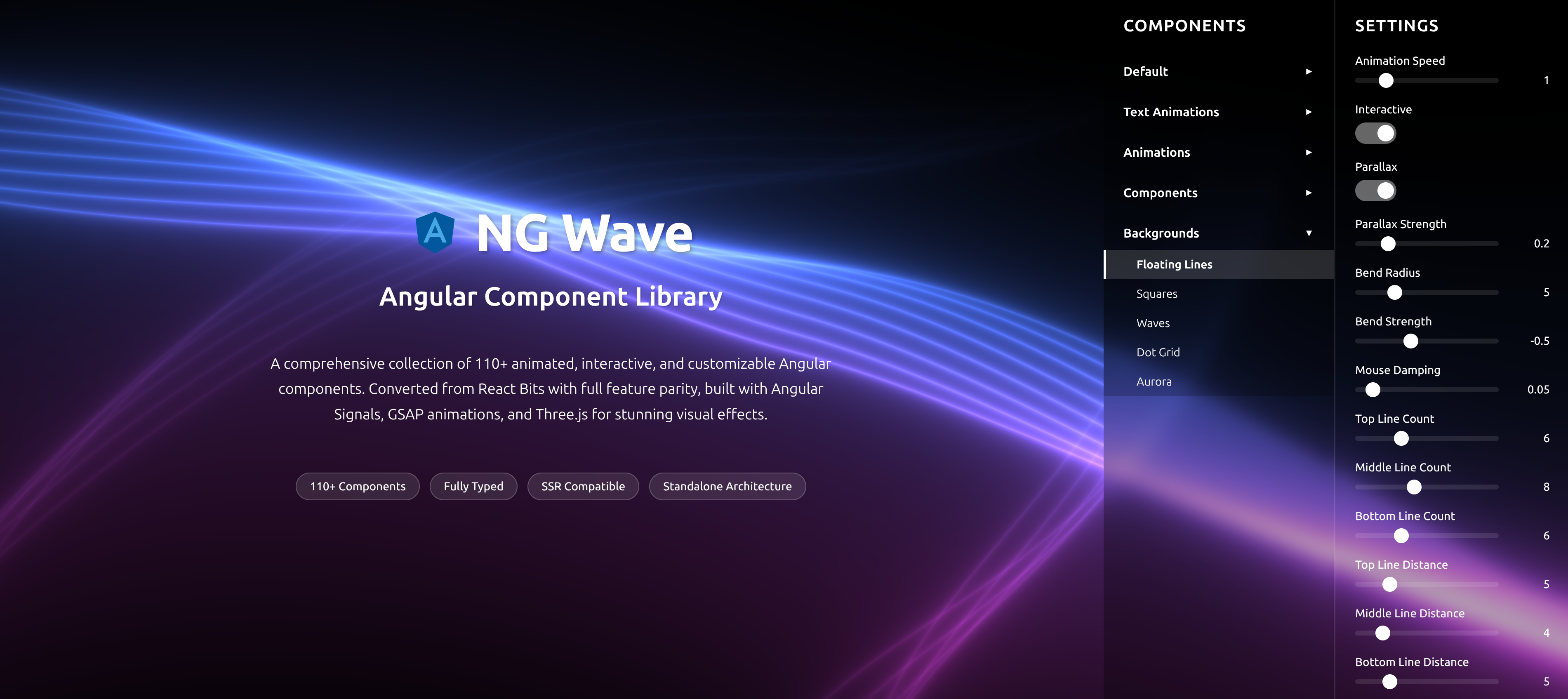
NG Wave
Angular Component Library
A comprehensive collection of 110+ animated, interactive, and customizable Angular components. Converted from React Bits with full feature parity, built with Angular Signals, GSAP animations, and Three.js for stunning visual effects.
Explore Components