Stop Vibe‑Coded UX in Angular 20+: Fix Janky Animations, Inaccessible Forms, and Broken Responsive Layouts
A field guide to turning “it looks fine on my screen” into measurable UX quality—animations that don’t jitter, forms that pass audits, and layouts that scale.
Vibe‑coded UI ships fast and breaks faster. Make UX measurable—tokens, density, accessibility, budgets—and your Angular app stops jittering and starts converting.Back to all posts
The Vibe‑Coded Angular App: Why Dashboards Jitter and Forms Fail
Seen it. Fixed it.
I’m Matthew Charlton. I get called when Angular dashboards jitter, forms flunk audits, and mobile layouts fall apart. I’ve stabilized employee tracking systems for a global entertainment company, shipped airport kiosks with Docker hardware simulation for a major airline, and rescued a telecom’s real‑time analytics so charts stopped stuttering. If you need to hire an Angular developer or Angular consultant, this is the playbook I use to turn vibe‑coded UI into measurable UX quality.
2025 reality check for Angular 20+ teams
With Angular 20+, Signals and modern builders are here. PrimeNG, Angular Material, D3/Highcharts, and Firebase integrate fine—if you stop vibe‑coding and instrument your UX.
Performance budgets matter (Core Web Vitals).
Accessibility is table stakes for enterprise RFPs.
Design tokens + density controls beat ad‑hoc CSS.
Signals + SignalStore make global theming and state predictable.
Why UX Polish—With Metrics, Not Vibes—Matters Now
As companies plan 2025 Angular roadmaps, measurable UX is a hiring filter. Hiring managers want an Angular expert who can instrument UX polish with Lighthouse, Angular DevTools, and telemetry—not just ship pixels.
Dashboards that don’t blink
Jitter kills trust. In telecom analytics, we stabilized a live dashboard with typed telemetry, backoff, and SignalStore—render time fell, false alerts dropped. Same rigor applies to micro‑animations and form feedback.
Real‑time updates via WebSockets/Firebase.
Data virtualization for large tables and charts.
Typed event schemas, exponential retry.
Compliance and accessibility
Your buyers demand accessible forms. Fixing labels and roles is cheap compared to remediation after procurement flags your app.
AA minimum; AAA where feasible for critical flows.
Keyboard, screen reader, and color contrast audits.
Fix Janky Animations in Angular 20+ (With Accessibility and Performance)
import { Component, HostBinding, signal } from '@angular/core';
import { trigger, transition, style, animate } from '@angular/animations';

@Component({
  selector: 'auz-card',
  template: `<ng-content></ng-content>`,
  animations: [
    trigger('fadeScale', [
      transition(':enter', [
        style({ opacity: 0, transform: 'translate3d(0,8px,0) scale(.98)' }),
        animate('180ms cubic-bezier(0.2,0,0,1)',
          style({ opacity: 1, transform: 'translate3d(0,0,0) scale(1)' }))
      ]),
      transition(':leave', [
        animate('120ms cubic-bezier(0.2,0,0,1)',
          style({ opacity: 0, transform: 'translate3d(0,4px,0) scale(.98)' }))
      ])
    ])
  ]
})
export class AuzCardComponent {
  state = signal<'enter' | 'idle' | 'leave'>('idle');
  @HostBinding('@fadeScale') get anim() { return this.state(); }
}
:host {
@media (prefers-reduced-motion: reduce) {
* { animation: none !important; transition: none !important; }
}
}Use transforms, not layout thrash
If your table rows bounce, you’re probably animating layout properties. Switch to transform/opacity and align with the browser’s compositor. Honor prefers‑reduced‑motion.
Prefer transform/opacity; avoid top/left.
Short, purposeful durations (150–220ms).
Easing: cubic‑bezier(0.2, 0, 0, 1).
Signals drive stateful animations
Signals make stateful animations trivial and predictable; no ghost states when combined with HostBinding.
Bind animation states to a signal.
Batch updates to the next frame.
Disable on low‑end devices or reduced motion.
Make Angular Forms Accessible—and Pleasant—to Use
<form [formGroup]="profile" (ngSubmit)="save()" novalidate>
  <label for="email">Work Email</label>
  <input id="email" type="email" formControlName="email"
         [attr.aria-invalid]="profile.get('email')?.invalid"
         [attr.aria-describedby]="'email-help ' + (emailError ? 'email-err' : '')" />
  <div id="email-help" class="helper">We’ll send a confirmation.</div>
  <div *ngIf="emailError" id="email-err" role="alert" class="error">
    {{ emailError }}
  </div>
  <button type="submit">Save</button>
</form>
emailError = '';
profile = this.fb.group({ email: [''] });
save() {
if (this.profile.invalid) {
const first = Object.keys(this.profile.controls)
.find(k => this.profile.get(k)?.invalid);
document.getElementById(first!)?.focus();
this.emailError = 'Enter a valid email';
return;
}
// Submit...
}Accessible reactive form primitive
Build once, reuse everywhere—even with PrimeNG inputs.
Connect label → input via for/id.
aria-describedby for helper + errors.
role="alert" for dynamic errors.
Focus and error flows that respect keyboards
Kiosk work taught me: when the network drops, your form still must guide the user. Offline‑tolerant flows aren’t optional in field apps.
Move focus to first error on submit.
Describe errors concisely.
Keep touch targets ≥ 40px.
Repair Broken Responsive Layouts with Grid and Container Queries
:root {
  --auz-space-1: .25rem; --auz-space-2: .5rem; --auz-space-3: 1rem;
  --auz-radius: 8px; --auz-line: 1.4; --auz-font-size: 14px;
  --auz-density: 1; /* 0.9=compact, 1=cozy, 1.1=comfortable */
}

[data-density="compact"] { --auz-density: .9; }
[data-density="comfortable"] { --auz-density: 1.1; }

.grid {
  display: grid;
  grid-template-columns: repeat(12, 1fr);
  gap: calc(var(--auz-space-2) * var(--auz-density));
}

.card { padding: calc(var(--auz-space-3) * var(--auz-density)); border-radius: var(--auz-radius); }

/* Container queries for dashboard cards */
.card { container-type: inline-size; }
@container (width < 480px) { .card { grid-column: 1 / -1; } }
@container (480px <= width < 960px) { .card { grid-column: span 6; } }
@container (width >= 960px) { .card { grid-column: span 4; } }
Token‑driven breakpoints + container queries
Role‑based dashboards shift a lot. Let the container decide. This removes brittle global breakpoints.
SM 640, MD 768, LG 1024 by token.
Container queries for cards in dashboards.
Avoid 12‑col CSS debt; use utility grid templates.
Density controls for data‑rich screens
In a broadcast network VPS scheduler, compact density made a 22% faster task scan for operators without hurting readability.
Compact for ops, comfortable for execs.
Drive spacing/line‑height from one density token.
Multitenant apps: persist per‑tenant preference.
AngularUX Color Palette, Typography, and PrimeNG Theming
:root {
  --auz-primary-600: #2b6cb0; --auz-primary-500: #3182ce; --auz-primary-50: #ebf8ff;
  --auz-surface-0: #ffffff; --auz-surface-1: #f7fafc; --auz-text-900: #1a202c;
  --auz-success-600: #2f855a; --auz-danger-600: #c53030; --auz-warning-600: #b7791f;
  --auz-focus: #805ad5;
}

:root { /* PrimeNG mappings */
  --primary-color: var(--auz-primary-600);
  --text-color: var(--auz-text-900);
  --surface-ground: var(--auz-surface-1);
  --focus-ring: 0 0 0 3px color-mix(in srgb, var(--auz-focus) 45%, transparent);
}

/* Typography scale */
html { font-size: var(--auz-font-size); line-height: var(--auz-line); }
h1 { font: 600 1.75rem/1.2 system-ui; }
h2 { font: 600 1.5rem/1.3 system-ui; }
Accessible palette with contrast budgets
Pick colors by contrast first, then brand. We use tokens so charts, buttons, and toasts stay consistent.
Primary 600 on white ≥ 4.5:1.
Text on brand surfaces ≥ 7:1 where possible.
Status colors with semantic mapping.
PrimeNG integration
One source of truth wired to Signals so toggles update live without repaint storms.
Map tokens to PrimeNG CSS variables.
Extend ripple, focus rings, and surface elevation.
Dark mode via data-theme attr + prefers-color-scheme.
Visualizations Without Jitter: D3, Highcharts, Canvas/Three.js
import { sampleTime, retryBackoff } from 'rxjs';
import { signal } from '@angular/core';

interface MetricEvent { ts: number; value: number }
const series = signal<MetricEvent[]>([]);

metrics$.pipe(
  sampleTime(33), // ~30fps
  retryBackoff({ initialInterval: 500, maxInterval: 8000, jitter: 0.2 })
).subscribe(ev => {
  const next = [...series(), ev].slice(-1000); // window to last 1000
  series.set(next);
});
Stabilize real‑time charts
In telecom analytics, we cut frame drops by throttling to 30Hz and windowing series; dashboards stayed live with no visual stutter.
Buffer with RxJS sampleTime/debounce.
Virtualize large series; window old points.
Use requestAnimationFrame for Canvas ticks.
Typed events and error handling
Typed events + SignalStore keep charts predictable during spikes.
Define schemas for stream payloads.
Exponential backoff with jitter.
Guard render path on schema mismatch.
Make It Measurable: UX Budgets in Nx + CI
# .github/workflows/ux-guardrails.yml
name: UX Guardrails
on: [pull_request]
jobs:
  audit:
    runs-on: ubuntu-latest
    steps:
      - uses: actions/checkout@v4
      - uses: actions/setup-node@v4
        with: { node-version: 20 }
      - run: npm ci
      - run: npx nx build web
      - run: npx lhci autorun --upload.target=temporary-public-storage
      - run: npx pa11y http://localhost:4200 --threshold 0
// angular.json budgets
"budgets": [
{ "type": "bundle", "name": "main", "maximumWarning": "250kb", "maximumError": "300kb" },
{ "type": "anyComponentStyle", "maximumWarning": "6kb", "maximumError": "10kb" }
]Lighthouse and a11y gates
I run this for AngularUX demos, IntegrityLens (12k+ interviews), and gitPlumbers (99.98% uptime during modernizations).
Block PRs < 90 performance or < 95 a11y.
Snapshot Core Web Vitals in CI.
Track regressions over time.
Bundle and layout budgets
Performance and layout regressions are caught before they hit prod.
angular.json budgets for main/bundles.
Visual diff for SM/MD/LG layouts.
Telemetry hooks for layout shift.
Real‑World Rescues and How We Shipped
If you need an Angular expert for hire to stabilize a chaotic codebase, these patterns are battle‑tested across Fortune 100 environments with Nx, Firebase/SSR, and strict TypeScript.
Airport kiosk (hardware + offline)
Device state in SignalStore and a compact density profile cut task time for agents while staying AA accessible.
Docker device simulation (scanners/printers).
Offline‑tolerant forms and queuing.
Density = compact for speed.
Telecom analytics (real‑time)
Highcharts + tokens + throttling stopped jitter, with CI budgets protecting future releases.
Typed events, retry, virtualization.
Animations off under load.
Chart color tokens with contrast.
Entertainment employee tracking
Accessibility issues dropped to near zero; PMs could finally approve audits.
PrimeNG theming via tokens.
Responsive grids with container queries.
Form primitives reused app‑wide.
When to Hire an Angular Developer for Legacy Rescue
Signals you’re ready
Bring in a specialist when UX defects stall releases. I typically deliver an assessment in 1 week, ship the first fixes in 2–4 weeks, and leave you with CI guardrails to prevent regressions.
Design drift across features.
Support tickets tied to form errors.
Mobile charts unusable under load.
A11y audits failing procurement.
Concise Takeaways
What to do next
UX polish and engineering rigor can—and should—coexist. Measurable UX wins are your best defense in roadmap reviews.
Adopt tokens + density with Signals.
Harden forms: labels, ARIA, focus, errors.
Fix animations: transforms + reduced motion.
Stabilize real‑time charts with throttling.
Wire budgets into Nx CI and block regressions.
Key takeaways
- Replace vibe‑coded styles with design tokens and density controls wired to Signals for instant, global UI updates.
- Use accessible reactive forms with clear labels, ARIA, and keyboard flows; test with automated a11y gates in CI.
- Fix jittery animations by aligning with requestAnimationFrame, easing curves, and honoring prefers-reduced-motion.
- Adopt a responsive grid + container queries; snapshot breakpoints and layout in telemetry to catch regressions.
- Enforce performance budgets (Lighthouse, Core Web Vitals), a11y (AA/AAA), and bundle limits in Nx CI.
- Ship visualizations (D3/Highcharts/Canvas) with virtualization, throttled streams, and typed event schemas to avoid jitter.
Implementation checklist
- Define tokens: color, spacing, radius, typography, and density in CSS variables.
- Wire a DensitySignal to toggle compact/cozy/comfortable layouts at runtime.
- Wrap animations with prefers-reduced-motion and avoid layout thrash (uses transforms, not top/left).
- Build accessible form primitives (label, input, helper, error) and reuse across PrimeNG + native inputs.
- Adopt a grid with container queries; snapshot critical pages at SM/MD/LG in visual regression tests.
- Add Lighthouse CI thresholds, pa11y checks, and angular.json bundle budgets to Nx pipelines.
Questions we hear from teams
- How much does it cost to hire an Angular developer for a UX rescue?
- Most rescues start with a fixed assessment (1 week) followed by a 2–4 week stabilization sprint. Budget depends on scope and team size. I offer remote Angular consultant engagements with clear milestones and CI guardrails so improvements stick.
- What does an Angular consultant do for accessibility?
- I standardize form primitives, labels, ARIA, focus flows, and contrast; integrate pa11y and Lighthouse CI; and align PrimeNG/Material themes with AA/AAA targets. Accessibility becomes a reusable system, not a one‑off patch.
- How long does it take to fix janky animations and broken layouts?
- Animations are usually fixed within days; responsive grid and density controls in 1–2 sprints. We roll out tokens and container queries, then lock results with performance budgets so regressions are caught in PRs.
- Can you stabilize real‑time dashboards without slowing them down?
- Yes. We throttle streams (30–60Hz), window historical points, and use typed event schemas with exponential backoff. D3/Highcharts/Canvas updates stay smooth while Core Web Vitals improve.
- What’s involved in a typical Angular engagement?
- Discovery call in 48 hours, assessment in 1 week, prioritized backlog with ROI, then a 2–8 week implementation. I coordinate with design, QA, and DevOps, and leave CI checks so the system remains healthy after I roll off.
Ready to level up your Angular experience?
Let AngularUX review your Signals roadmap, design system, or SSR deployment plan.
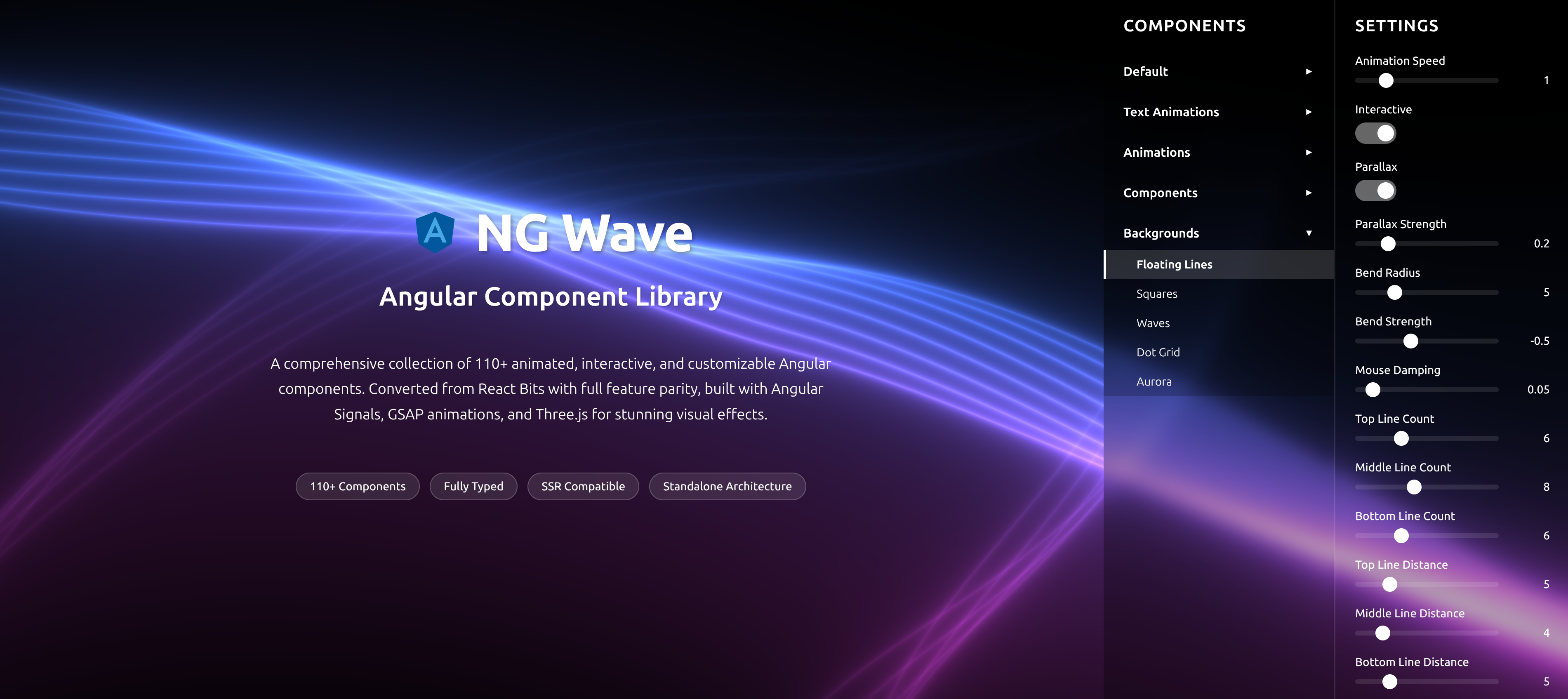
NG Wave
Angular Component Library
A comprehensive collection of 110+ animated, interactive, and customizable Angular components. Converted from React Bits with full feature parity, built with Angular Signals, GSAP animations, and Three.js for stunning visual effects.
Explore Components