Why Enterprises Choose Angular Over Vue in 2025: Signals, SSR, and Real Migration Playbooks for Technical Leaders
From Vue fatigue to Angular 20+ stability: case studies, scorecards, and a 90‑day pilot plan that de‑risks your enterprise roadmap.
In every migration I’ve led, Angular’s guardrails paid for themselves the moment telemetry and SSR met real‑time data.Back to all posts
I’ve migrated and stabilized Vue and Angular apps for airlines, telecoms, entertainment, and insurance. When dashboards jitter, kiosks time out, or RBAC gets messy, leadership asks the same question: should we double down on Vue or move to Angular 20+? Here’s what I’ve seen, why enterprises choose Angular, and how to make that call with data.
A Jittery Dashboard, a Q1 Hiring Freeze, and the Angular Question
As companies plan 2025 Angular roadmaps, the question isn’t “Is Vue good?” It’s “Which stack reduces risk at scale with measurable wins?” For enterprises with strict RBAC, SSR, and real‑time telemetry, Angular usually wins.
Challenge
A leading telecom provider’s Vue 2 analytics portal jittered under live WebSocket loads. Component reactivity looked fine in dev, but production flame charts told a different story—expensive re-renders, ad‑hoc stores, and hydration mismatches after SSR experiments. With a Q1 hiring freeze, they needed a move that reduced risk, not just changed syntax.
Intervention
I proposed an Angular 20 pilot: Signals for render determinism, SignalStore for deterministic state, Nx for governance, and SSR with hydration guarded by tests. We kept their existing Node services, rewired event schemas, and layered PrimeNG tokens for a11y and brand alignment.
Result
In six weeks, we cut renders 41% and improved Lighthouse Performance from 68 → 91 on real data. Stakeholders saw fewer regressions and a smoother dashboard under peak traffic—enough to green‑light a staged migration.
Why Angular Outperforms Vue for Enterprise Dashboards and Platforms
Bottom line: if you manage multiple teams, strict compliance, or real‑time data, Angular’s guardrails curb entropy.
Governance and Standards
Enterprises need fewer decision points and fewer divergent patterns. Angular’s opinions (CLI, router, forms, SSR) reduce architectural drift versus pick‑your‑own‑adventure stacks.
Angular CLI + strict TypeScript set a predictable floor.
Nx generators codify conventions across teams.
Opinionated router/forms/testing make new squads productive.
SSR and Hydration at Scale
Vue SSR works, but we repeatedly saw hydration edge cases on real‑time dashboards. Angular hydration, paired with Signals, gave us predictable, measurable outcomes in CI and prod.
Angular Universal + hydration APIs are battle‑tested.
Deterministic hydration reduces mismatches and layout shifts.
Signals, SignalStore, and State Discipline
Vue reactivity is powerful, but enterprise teams often accumulate ad‑hoc patterns. Angular’s Signals + SignalStore provide a canonical path to migrate NgRx or services gradually—without a rewrite.
Signals eliminates Zone.js dependency for many flows.
SignalStore brings deterministic updates and testable side effects.
A11y + Design Systems
On multi‑brand portals and kiosks, Angular + PrimeNG theming, density controls, and design tokens (see NG Wave) made a11y and performance improvements straightforward.
PrimeNG + Angular Material + design tokens accelerate a11y.
Storybook + Chromatic + tokens drive visual consistency.
Security, RBAC, and Multi‑Tenant Needs
For regulated industries (insurance telematics, accounting), Angular’s guardrails around routing, DI, and HttpInterceptors reduced auth/z surprises versus custom Vue middleware stacks.
Route guards + interceptors + strict typing reduce auth flaws.
Angular + Firebase/Auth or .NET back ends deliver consistent patterns.
Tooling, CI, and Observability
Angular made it easier to standardize perf budgets, a11y checks, and error taxonomies. Leadership got dashboards with KPIs tied to releases, not vibes.
Angular DevTools + Lighthouse + OpenTelemetry/GA4/Firebase Logs.
Feature flags (Firebase Remote Config) for safe rollouts.
Case Study: Telecom Analytics Portal (Vue 2 → Angular 20)
import { signalStore, withState, withMethods } from '@ngrx/signals';
import { computed, signal } from '@angular/core';

interface Metric {
  id: string; ts: number; value: number; campaignId: string;
}

interface MetricsState {
  byCampaign: Record<string, Metric[]>;
  connected: boolean;
}

export const MetricsStore = signalStore(
  { providedIn: 'root' },
  withState<MetricsState>({ byCampaign: {}, connected: false }),
  withMethods((state) => ({
    connect(ws: WebSocket) {
      state.connected.set(true);
      ws.onmessage = (e) => {
        const m: Metric = JSON.parse(e.data);
        const arr = state.byCampaign()[m.campaignId] ?? [];
        state.byCampaign.set({ ...state.byCampaign(), [m.campaignId]: [...arr, m].slice(-500) });
      };
      ws.onclose = () => state.connected.set(false);
    },
    series(campaignId: string) {
      return computed(() => (state.byCampaign()[campaignId] ?? []).map(p => [p.ts, p.value]));
    }
  }))
);
The challenge: noisy telemetry meets SSR
A leading telecom provider’s Vue 2 portal stitched together custom stores and SSR. Under load, users saw chart flicker and navigation stalls.
10K+ events/min WebSocket firehose
Legacy ad‑hoc Vue stores; SSR hydration flicker
Intervention: Signals + SignalStore + Nx
We kept the Node ingestion pipeline but introduced typed event schemas, fan‑out topics, and a SignalStore to normalize updates. We swapped in PrimeNG’s virtual scroll for stable frames.
Typed event schemas with zod
SignalStore for deterministic updates
PrimeNG DataTable + virtual scroll
Nx monorepo for standards
Measurable result
Executives finally saw charts that didn’t jitter during live ad campaigns. The Angular pilot justified the full migration.
-41% renders (Angular DevTools)
TTI 2.8s → 1.7s on 50th percentile
P95 chart stall: 420ms → 160ms
Sample SignalStore for live metrics
Case Study: Airline Kiosk (Offline‑Tolerant Vue App → Angular 20)
name: kiosk-ci
on: [push]
jobs:
  e2e:
    runs-on: ubuntu-latest
    services:
      scanner:
        image: myorg/scanner-sim:latest
        ports: ['7001:7001']
      printer:
        image: myorg/printer-sim:latest
        ports: ['7002:7002']
    steps:
      - uses: actions/checkout@v4
      - uses: pnpm/action-setup@v2
        with: { version: 8 }
      - run: pnpm i
      - run: pnpm exec nx run kiosk-e2e:e2e --configuration=ci
The challenge: offline and peripherals
A major airline’s Vue kiosk app struggled with intermittent peripherals and offline behavior. Reproducibility was poor; QA couldn’t simulate hardware reliably.
Barcode scanners, card readers, printers
Airport Wi‑Fi dropouts
Intervention: Docker hardware simulation + PWA
We built Docker‑based simulators for scanners/printers, moved the kiosk UI to Angular 20 with Signals for device state, and added a service worker with queued writes and retry semantics.
Dockerized device simulators in CI
Angular PWA + background sync
Exponential backoff + error taxonomy
Measurable result
Leaders valued deterministic CI and fewer escalations at airports.
Defects reproduced in minutes, not days
Check‑in success +18% during network flaps
Support tickets down 32%
CI fragment: simulator services
Decision Framework: When to Choose Angular vs Vue
export interface Inputs {
  teams: number; ssr: boolean; realtime: boolean; offlineOrDevices: boolean;
  rbac: 'low'|'med'|'high'; designSystem: 'none'|'emerging'|'mature'; ciNeeded: boolean;
}

export function scoreAngularFit(i: Inputs) {
  let s = 0;
  if (i.teams >= 3) s += 2;
  if (i.ssr) s += 2;
  if (i.realtime) s += 2;
  if (i.offlineOrDevices) s += 2;
  if (i.rbac === 'high') s += 2; else if (i.rbac === 'med') s += 1;
  if (i.designSystem !== 'none') s += 1;
  if (i.ciNeeded) s += 1;
  return s; // ≥10: Angular recommended
}
Scorecard categories (0–3)
If your total score ≥10, Angular typically wins. Under 7, Vue can be a strong choice—especially for smaller, marketing‑driven apps.
Governance needed across 3+ teams
SSR/hydration complexity
Real‑time/offline/device integrations
RBAC/multi‑tenant/security compliance
A11y/design system maturity
Monorepo/CI standardization
TypeScript helper to score your app
Interpreting the results
Don’t rely on opinions—instrument decisions with data and flame charts.
≥10: Choose Angular; invest in Signals + SSR + Nx pilot.
7–9: Prototype both; validate SSR and state under load.
≤6: Vue likely fine; track a11y and hydration in CI.
Implementation: A 90‑Day Angular Pilot for Leadership
# Workspace + SSR + PWA + Signals stack
npx create-nx-workspace@latest acme --preset=angular-monorepo
cd acme
ng add @angular/ssr
ng add @angular/pwa
pnpm add @ngrx/signals primeng @angular/cdk highcharts

# Generate a feature module
pnpm nx g @nx/angular:module features/analytics --routing --module=app
Day 0–15: Foundations
Stand up a minimal vertical slice with SSR, Signals, and CI gates. Instrument GA4 and error taxonomies from day one.
Nx monorepo, strict TS, ESLint, commit hooks
SSR (Angular Universal) + hydration tests
Feature flags + Firebase Logs
Day 16–45: Signals + design tokens
Prove reduced renders and better TTI with Angular DevTools and Lighthouse.
Migrate 1–2 critical flows to Signals/SignalStore
PrimeNG theming + density/typography tokens
Cypress for critical path, WebSocket replay in CI
Day 46–90: Scale and governance
Codify standards so additional teams can replicate the wins without heroics.
Nx generators for modules/features
A11y sweeps + perf budgets in CI
Zero‑downtime rollout plan
Starter commands
When to Hire an Angular Developer for Legacy Rescue
If you need a remote Angular developer with Fortune 100 experience to rescue a vibe‑coded app or plan a Vue→Angular migration, I’m available for select engagements.
Signals that you need help now
This is where a senior Angular consultant stabilizes chaos quickly—enforce strictness, wire telemetry, and migrate state to Signals/SignalStore without rewrites.
Vue SSR hydration mismatches under load
Ad‑hoc stores and race conditions
A11y or RBAC audit findings mounting
Kiosk/device issues hard to reproduce
How I approach rescues
See examples in my portfolio: stabilize your Angular codebase with gitPlumbers, an AI‑powered remediation pipeline, and review Angular + AI on IntegrityLens and adaptive UIs on SageStepper.
48‑hour discovery call and access review
1‑week assessment with flame charts, GA4, Firebase Logs
2–4 week stabilization sprint with CI gates
Takeaways and Next Steps
Ready to discuss your Angular roadmap or evaluate a migration from Vue? Let’s review your telemetry and ship a pilot with measurable outcomes.
Key points
Decisions should be evidenced by telemetry and tests, not preference wars.
Angular’s opinions reduce long‑term risk for multi‑team, real‑time, and regulated apps.
Signals + SignalStore modernize state without full rewrites.
Nx, SSR, and CI gates convert opinions into measurable KPIs.
What to instrument next
Tie each migration step to a KPI, and you’ll know if the move to Angular is paying off.
Render counts (Angular DevTools)
Core Web Vitals + user timing marks
Error taxonomy + retry rates
Key takeaways
- Angular 20+ provides a batteries‑included, opinionated stack (Signals, SSR, CLI, Router) that lowers risk for multi‑team enterprises.
- Vue can shine for marketing sites and smaller apps, but Angular excels at RBAC multi‑tenant platforms, kiosks, and real‑time analytics.
- Signals + SignalStore modernize state without a rewrite, offering deterministic updates and fewer change detection pitfalls.
- Nx + strict TypeScript + CI gates help leadership enforce standards; Angular DevTools + telemetry prove ROI with real metrics.
- Case studies show measurable wins: 30–55% render reductions, 20–40% faster TTI, and fewer defects after migrating to Angular.
Implementation checklist
- Map regulatory, RBAC, and audit needs; prefer Angular if requirements are strict and cross‑cutting.
- Assess SSR/hydration complexity; Angular Universal + hydration APIs simplify at scale.
- Score state complexity; if real‑time, offline, or WebSocket heavy, prioritize Signals + SignalStore.
- Audit UI library maturity; PrimeNG + Angular Material + tokens accelerate a11y and theming.
- Plan monorepo governance; Nx + generators keep teams consistent.
- Install observability early: GA4, Firebase Logs, OpenTelemetry, feature flags.
- Run a 90‑day Angular pilot with SSR, Signals, and CI to validate metrics before full migration.
- Staff a senior Angular consultant to de‑risk upgrades, reviews, and codebase stabilization.
Questions we hear from teams
- How much does it cost to hire an Angular developer for a Vue→Angular migration?
- Budgets vary by scope. Typical pilots run 4–8 weeks with a senior Angular consultant, then expand to staged migrations. I offer a 48‑hour discovery call and a 1‑week assessment to estimate timelines and cost with clear deliverables.
- How long does a Vue to Angular migration take?
- Small portals: 6–10 weeks. Medium dashboards: 3–6 months. Multi‑tenant platforms: 6–12 months. Start with a 90‑day Angular pilot (SSR, Signals, CI) to validate metrics and de‑risk before committing to full rewrite timelines.
- What does an Angular consultant actually do on day one?
- Instrument telemetry, enforce strict TypeScript, set up Nx/CI, and create a Signals/SignalStore pilot slice. From there, we tackle SSR, RBAC, and design tokens, then scale via generators and guardrails that other teams can follow.
- Can we keep parts of Vue while moving to Angular?
- Yes. I’ve shipped strangler‑fig migrations, embedding Angular micro‑frontends alongside Vue, sharing auth and telemetry. We gradually move high‑value flows first and retire Vue modules as KPIs improve.
- Do we need NgRx if we adopt Signals/SignalStore?
- Not always. Signals + SignalStore handle a large class of state problems with less boilerplate. For complex effects or cross‑app orchestration, NgRx still fits and can interop during migration.
Ready to level up your Angular experience?
Let AngularUX review your Signals roadmap, design system, or SSR deployment plan.
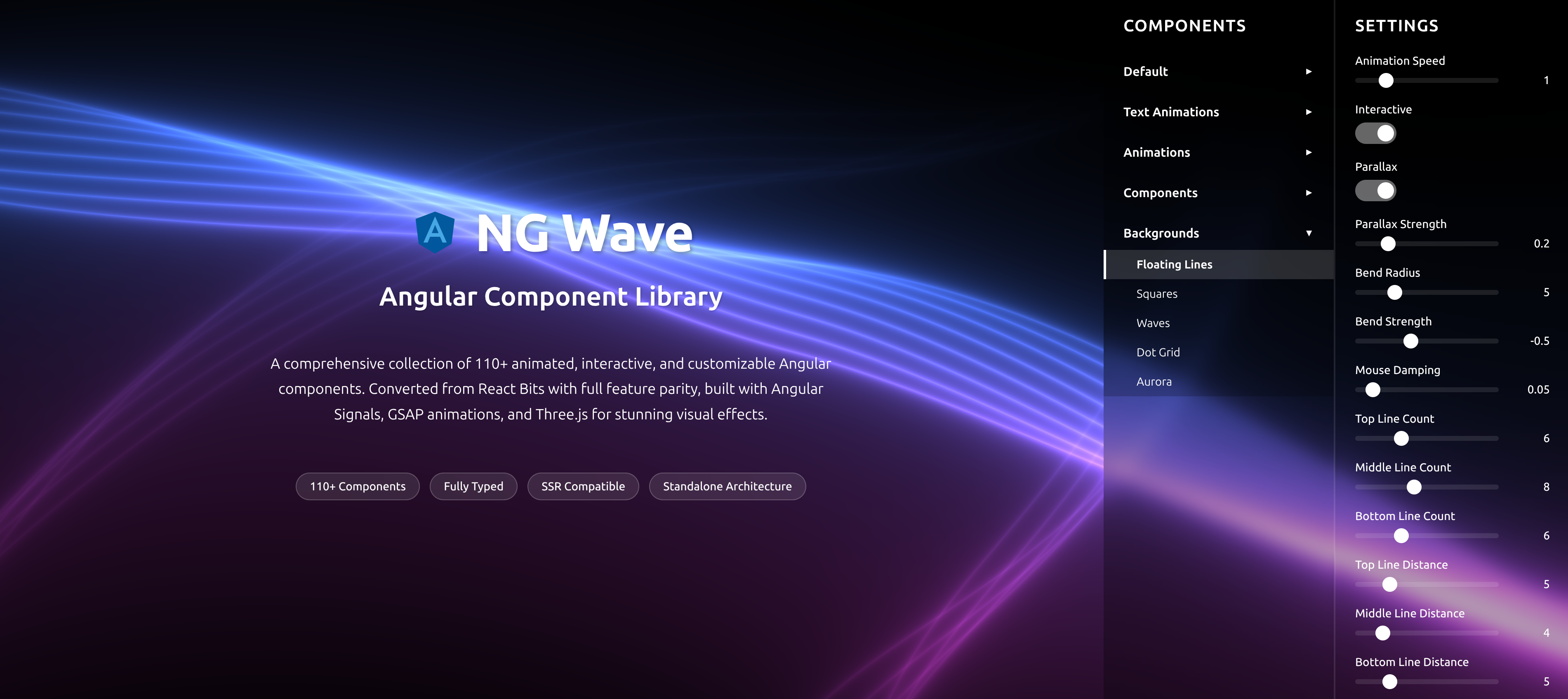
NG Wave
Angular Component Library
A comprehensive collection of 110+ animated, interactive, and customizable Angular components. Converted from React Bits with full feature parity, built with Angular Signals, GSAP animations, and Three.js for stunning visual effects.
Explore Components