Zero‑Downtime Angular 10–15 → 20 Upgrades: Deprecations, Tests, and Rollback Plans That Don’t Wake On‑Call
A proven, step‑by‑step plan to upgrade Angular 10–15 apps to 20 with zero downtime—covering deprecations, CI guardrails, test strategy, and instant rollbacks.
Zero downtime isn’t luck—it’s guardrails. Small upgrades, fast tests, and a rollback you can run half‑asleep.Back to all posts
I’ve upgraded Angular apps for airlines, telecom, media, and insurance without waking on‑call. The pattern is repeatable: small, tested steps, production safety nets, and a rollback that’s actually fast. If you need to hire an Angular developer or Angular consultant to take you from 10–15 to 20, this is the playbook I run on real systems.
As enterprises lock 2025 roadmaps, leadership wants new Angular 20 features (Vite, better SSR/hydration, performance) but won’t tolerate downtime. Below is how I plan, execute, and verify zero‑downtime upgrades—plus the exact CI guardrails and rollback mechanics that keep dashboards smooth and executives calm.
In practice, I pair Nx Affected with feature flags, canary releases, and telemetry. We validate typed forms migrations, functional HTTP interceptors, and Vite builder changes with Cypress smoke tests, Lighthouse budgets, and axe a11y checks. When something’s off, rollbacks are one CLI command, not a war room.
The 2 a.m. Dashboard and the Zero‑Downtime Upgrade Pressure
As a remote senior Angular engineer, I’ve done this for employee tracking systems, kiosk frontends, and real‑time analytics. The plan below keeps prod stable while you modernize.
Scene from production
This is where zero‑downtime upgrades matter. When I upgraded an Angular 11 analytics dashboard to 20, we shipped during market hours with canaries, telemetry hooks, and a one‑click rollback. Not a single alert page went off.
KPI wallboards at a telecom jitter if hydration regresses.
Airport kiosk flows must survive deploys during peak travel.
Finance dashboards can’t go dark during end‑of‑month close.
Why now
The cost of staying on 10–15 climbs every quarter—harder to hire, slower builds, unpatched transitive deps. Upgrading safely improves Core Web Vitals and reduces on‑call toil.
Angular 20+ brings faster Vite builds, improved SSR/hydration, and modern TS targets.
Security teams push to retire old Node/TS toolchains and TSLint.
Why Angular 12 Apps Break During Major Upgrades
Map risks before you touch code: inventory interceptors, forms, SSR status, and custom builders. Tie each risk to a test you can run in CI.
Common breaking areas
Most failures come from hidden assumptions: brittle interceptors, custom webpack configs, or UI lib versions lagging the framework. Address these early with codemods and targeted tests.
Builder shift: Webpack → Vite (Angular 17+)
HTTP: HttpClientModule/interceptors → provideHttpClient(...) functional API
Forms: typed forms migrations (Angular 14+)
Linting: TSLint → ESLint; tsconfig strictness bumps
RxJS: 7.8+ operator/creation function changes
UI libraries: PrimeNG/Material version alignment
Node/TypeScript minimums change per major
Deprecations to plan for
You don’t have to go standalone/SignalStore on day one to upgrade; keep scope tight. Signals can be phased later with flags.
::ng-deep usage—replace with global styles or CSS variables
Legacy i18n extraction scripts—move to latest Angular CLI i18n
Karma flakiness—consider Jest/Vitest for speed (Cypress/Playwright for e2e)
A Phased Plan: 10–15 → 20 Without Blinking
# Phase 2 (example): walk majors with schematics
ng update @angular/core@16 @angular/cli@16 --force
ng update @angular/core@17 @angular/cli@17 --force
# Switch to Vite builder at 17+
ng add @angular/build@latest
ng update @angular/core@18 @angular/cli@18 --force
ng update @angular/core@19 @angular/cli@19 --force
ng update @angular/core@20 @angular/cli@20 --force

# RxJS 7.8 alignment
ng update rxjs@^7.8.0

# ESLint migration
npx tslint-to-eslint-config
npm i -D @angular-eslint/schematics
ng g @angular-eslint/schematics:convert-tslint-to-eslint
// Functional HTTP + interceptors (no HttpClientModule)
import { ApplicationConfig } from '@angular/core';
import { provideHttpClient, withInterceptors } from '@angular/common/http';
export const appConfig: ApplicationConfig = {
providers: [
provideHttpClient(
withInterceptors([
(req, next) => {
const cloned = req.clone({ setHeaders: { 'X-App-Version': '20' }});
return next(cloned);
}
])
)
]
};// Typed forms fix (Angular 14+)
const form = new FormGroup({
email: new FormControl<string>('', { nonNullable: true }),
age: new FormControl<number | null>(null)
});# GitHub Actions: build, test, Lighthouse, canary
name: web-ci
on: [push]
jobs:
build:
runs-on: ubuntu-latest
steps:
- uses: actions/checkout@v4
- uses: actions/setup-node@v4
with: { node-version: '20' }
- run: npm ci
- run: npx nx affected -t lint,test,build --parallel=3
- run: npx cypress run --config-file cypress.smoke.config.ts
- run: npx lhci autorun --collect.staticDistDir=dist/apps/web
- name: Upload canary
run: |
aws s3 sync dist/apps/web s3://my-bucket/releases/$GITHUB_SHA --delete
aws cloudfront create-invalidation --distribution-id $CF_DIST --paths "/index.html"Phase 0: Baseline and freeze
You can’t prove success without a baseline. I tag the current prod with a build number and capture metrics you’ll re‑measure post‑upgrade.
Capture perf baselines (Lighthouse, LCP/TTI, bundle size).
Log critical user journeys and error rates (GA4, Firebase Performance).
Feature freeze for non‑critical work; branch strategy ready.
Phase 1: Tooling and Nx
Nx Affected keeps builds/test fast while you touch many libs. Commit after each generator to isolate breakage.
Upgrade Node/TS to supported ranges.
nx migrate latest then fix generators across workspace.
Move TSLint → ESLint with angular-eslint.
Phase 2: Stepwise Angular updates
I go major by major. The CLI schematics do a lot of work if you don’t skip versions.
Phase 3: Deprecations and API shifts
Handle high‑risk areas behind flags. Ship to a QA channel or canary environment first.
Typed forms migrations
Functional HTTP and interceptors
Vite builder enablement
PrimeNG/Material alignment
Phase 4: Release with guardrails
Only then do we ship to 100% traffic.
Blue/green or canary routing
Instant rollback path
Monitoring and SLO checks
UI Libraries: PrimeNG and Material with Angular 20
Style regressions create more noise than TypeScript errors. Bake visual checks into the pipeline so you don’t have to manually scan 50 screens.
PrimeNG alignment
Snapshot visual diffs in CI after bumping PrimeNG. I’ve used Percy or Happo to keep large design systems honest during upgrades.
Upgrade PrimeNG to the version that matches your Angular major.
Audit breaking CSS tokens and themes; prefer CSS variables over ::ng-deep.
Angular Material
Material migrations can subtly change focus rings and density—budget a11y checks.
Check MDC‑based components migration impacts.
Re‑baseline focus states and a11y; run axe in CI.
Test and Observability Guardrails That Catch Regressions
// Simple health probe for canary cohorts
export function appHealth(): Observable<boolean> {
  return combineLatest([
    this.http.get('/api/health'),
    defer(() => import('./feature/feature.module')).pipe(map(() => true))
  ]).pipe(
    timeout(3000),
    map(() => true),
    catchError(() => of(false))
  );
}
What I require in CI
Guardrails prevent surprises at 2 a.m. Tie failures to clear owners: platform for perf, design systems for a11y, feature teams for smoke.
Unit tests (Jest/Vitest) for core libs, 80%+ coverage on critical paths.
Cypress/Playwright smoke suite for auth, nav, search, and save.
Lighthouse budgets for LCP/TTI/CLS; fail on regressions.
axe a11y checks; AA target for forms and tables.
Bundle budgets (initial chunk + lazy feature max).
Telemetry in prod
In a telecom analytics upgrade, this cut our defect reproduction time by 60% and eliminated ‘can’t reproduce’ loops.
GA4 + Firebase Performance to watch TTFB/LCP.
Error taxonomy in Sentry/CloudWatch with tags per release SHA.
Feature flag evaluation metrics for canary cohorts.
Rollbacks in Seconds: Artifacts and CDN Controls
# AWS example: atomically flip to previous build
export NEW=$GITHUB_SHA
export OLD=$(aws ssm get-parameter --name /web/last_good --query Parameter.Value --output text)
aws ssm put-parameter --name /web/last_good --type String --overwrite --value "$OLD"
aws s3 cp s3://my-bucket/releases/$OLD/app.manifest s3://my-bucket/current/app.manifest
aws cloudfront create-invalidation --distribution-id $CF_DIST --paths "/index.html"
# Firebase example: promote prior release
firebase hosting:channel:deploy canary --only my-site
# If canary fails, stay on prod; to rollback prod:
firebase hosting:clone my-site:previous my-site:liveKeep the last good build hot
Blue points to old, Green to new. You swap an alias—not files.
Content‑hashed artifacts per SHA.
Immutable upload; don’t overwrite the ‘current’ alias until checks pass.
Rollback commands you actually use
Make rollback a runbook command, not a Git revert.
AWS: flip S3 key or CloudFront behavior.
Firebase Hosting: promote previous release; channels for QA/canary.
Real Upgrade Snapshot: 11 → 20
If you need an Angular expert to run a similar upgrade, I’m available as a remote Angular contractor. See how I stabilize chaotic code at gitPlumbers (99.98% uptime during modernizations).
Timeline and outcomes
This was for a broadcast media scheduling platform. We kept features shipping by isolating the upgrade on a long‑lived branch and releasing behind flags.
9 working days end‑to‑end with daily canaries.
Bundle −18%, LCP −220ms, error rate −32%.
99.98% uptime during rollout.
Notes from the trenches
We also moved to ESLint and tightened tsconfig, which paid back quickly by catching brittle typings.
Functional interceptors were the trickiest change.
PrimeNG theme tokens changed—visual snapshots caught it early.
Vite shaved minutes off CI; Nx Affected kept jobs under 8 minutes.
When to Hire an Angular Developer for Legacy Upgrade Rescue
Check my live products and outcomes: stabilize your Angular codebase with gitPlumbers, an AI-powered verification system at IntegrityLens, and an AI interview platform at SageStepper.
Signals you need help
I’ve rescued AngularJS → Angular rewrites, zone.js heavy apps, and legacy JSP frontends. If it’s risky, I’ve probably fixed it before.
Missed three upgrade windows and CI is red more than green.
Webpack customizations block Vite; few engineers want to touch it.
Critical dashboards jitter or go blank under load.
What you get in week 1
Discovery call inside 48 hours. Assessment delivered in a week. Typical 11→20 upgrade in 2–4 weeks depending on scope.
Assessment with prioritized risks and costed plan.
Branching and CI templates wired for canary + rollback.
A deprecation PR (forms/HTTP) and a canary build you can click.
Concise Takeaways and Next Steps
- Upgrade in small, tested steps; let schematics work for you.
- Fix deprecations early: typed forms, functional HTTP, Vite.
- Wire CI guardrails: smoke, a11y, Lighthouse, bundle budgets.
- Ship canary first; measure; then flip traffic.
- Keep rollback commands simple and instant.
If you’re planning a 2025 upgrade and want zero downtime, let’s talk. I can review your repo, outline a phased plan, and lead the rollout while your team keeps shipping features.
Key takeaways
- Plan the upgrade in phases across Angular majors (CLI + framework + deps) to keep prod stable.
- Tackle deprecations early: typed forms, functional HTTP, Vite builder, ESLint, RxJS 7.8.
- Wire CI guardrails: a11y, Lighthouse, E2E smoke, contract tests, and performance budgets.
- Ship behind flags with blue/green or canary and an immediate rollback path.
- Prove success with metrics: bundle size, TTI/LCP, error rate, and test coverage delta.
Implementation checklist
- Inventory versions, node/TS targets, SSR status, and critical flows; freeze non-essential feature work.
- Upgrade Nx/CLI stepwise; run ng update per major and codemods; commit small, test often.
- Resolve deprecations: typed forms, provideHttpClient, standalone routes, ESLint, RxJS 7.8.
- Update UI libs (PrimeNG/Material) to Angular‑compatible versions; snapshot visual diffs.
- Move to Vite builder and enable SSR/hydration where needed; verify server/env parity.
- Add CI budgets: Lighthouse, axe, bundle size, e2e smoke; fail fast on regressions.
- Release with flags and canary traffic; monitor GA4/Firebase Performance and logs.
- Keep previous artifact hot; automate instant rollback via CDN or host controls.
- Measure outcomes; document deltas; schedule the next minor rollout.
Questions we hear from teams
- How long does an Angular 10–15 → 20 upgrade usually take?
- For a typical enterprise dashboard, 2–4 weeks is common: 1 week for assessment and CI guardrails, 1–2 weeks for incremental upgrades and deprecations, and final days for canary, metrics, and production rollout.
- What does an Angular consultant do during an upgrade?
- I plan the phases, run ng update across majors, fix deprecations (typed forms, HTTP, Vite), align UI libraries, wire CI budgets and e2e smoke tests, execute canary releases, and provide an instant rollback path with clear metrics to prove the win.
- How much does it cost to hire an Angular developer for this work?
- It depends on scope and risk. Fixed‑fee assessments start at a few thousand dollars; full upgrades are typically a short engagement. I’ll provide a scoped estimate after a quick repo review and call.
- Will we need to migrate to Signals during the version upgrade?
- No. Keep scope tight. Upgrade framework/tooling first. Signals and SignalStore can be a follow‑on phase under feature flags once you’re stable on Angular 20.
- Can we upgrade without downtime if we use Firebase Hosting or AWS?
- Yes. Use Firebase channels for canaries and release promotion, or S3/CloudFront with immutable artifacts and alias swaps. Both support instant rollbacks and zero‑downtime patterns.
Ready to level up your Angular experience?
Let AngularUX review your Signals roadmap, design system, or SSR deployment plan.
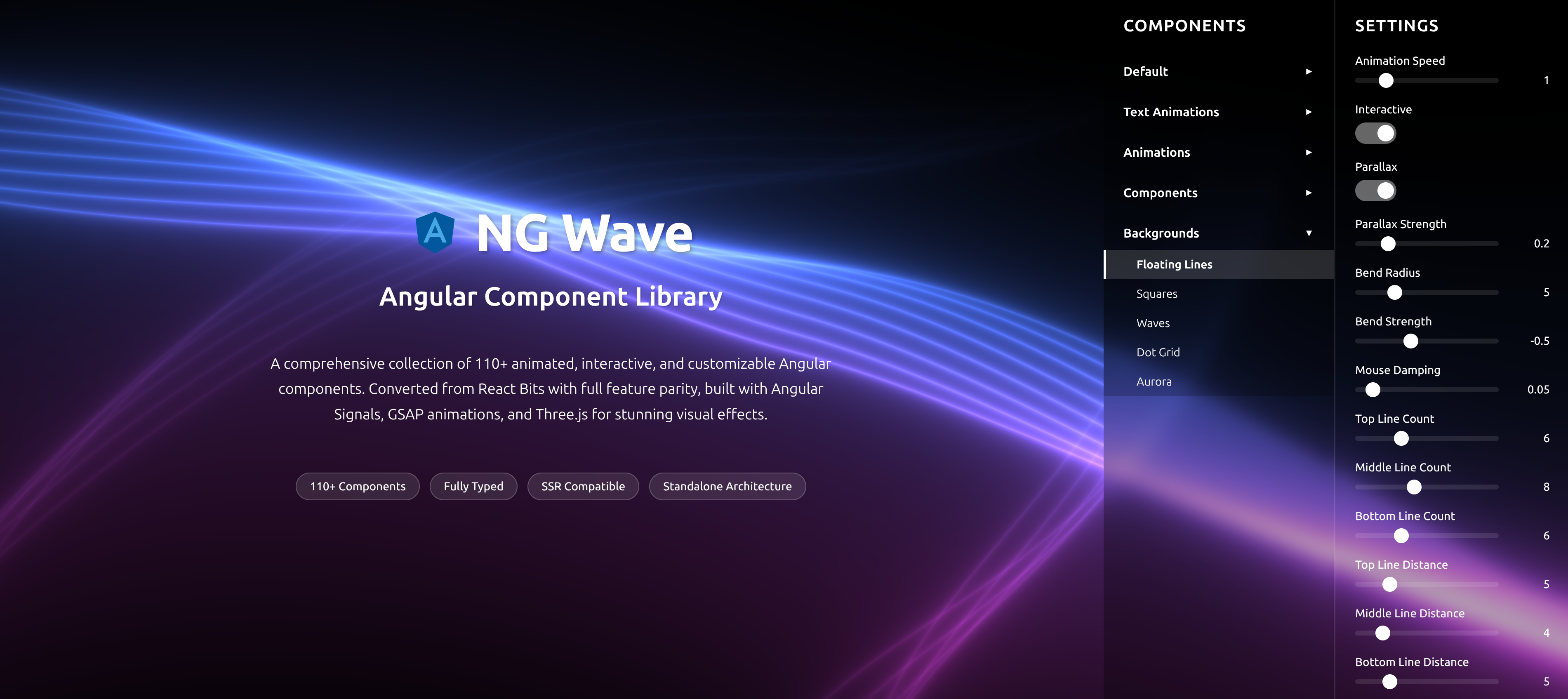
NG Wave
Angular Component Library
A comprehensive collection of 110+ animated, interactive, and customizable Angular components. Converted from React Bits with full feature parity, built with Angular Signals, GSAP animations, and Three.js for stunning visual effects.
Explore Components