Zero‑Downtime Angular 10‑15 → 20 Upgrades: Deprecations, Tests, and Rollback Plans That Actually Work
My proven playbook for upgrading Angular apps to 20+ without outages—step‑by‑step migrations, CI gates, canary deploys, and instant rollbacks.
Zero‑downtime isn’t luck—it’s CI gates, canaries, and a rollback you can execute in 30 seconds.Back to all posts
I’ve upgraded Angular apps for airlines, telecom analytics, and insurance telematics where the SLA was simple: don’t go down. If you need to hire an Angular developer or an Angular consultant to move from Angular 10–15 to 20+, here’s the exact approach I use to ship safely with measurable wins.
The dashboard that can’t go down: how to upgrade without users noticing
The 2 a.m. rule
On an airport kiosk project, a reboot meant a missed check‑in. On a telecom analytics dashboard, a blip meant lost ad dollars. Upgrading Angular under those constraints taught me to treat version bumps like production features: behind flags, canaried, measured, and instantly reversible.
2025 reality check
Your path must bridge both worlds without outages. This article shows the practical plan—tests, deprecations, CI/CD, and rollback mechanics.
Angular 20+ ships faster builders and Signals‑ready patterns.
Enterprise teams still depend on Angular 10–15 era modules and Webpack.
Why zero‑downtime upgrades matter for Angular 20+ teams
Budgets and risk
Zero‑downtime upgrades protect revenue dashboards, kiosks, and multi‑tenant portals while unblocking new features (Signals, SSR, deferrable views).
Q1/Q3 releases can’t tolerate regressions.
Security teams demand current LTS + dependency hygiene.
Hiring signal
If you need an Angular expert for hire, show them a plan with measurable outcomes and a 30‑second rollback.
Stakeholders ask for concrete rollback plans.
Directors want metrics: bundle reductions, INP, error rate.
Plan the path from 10–15 to 20 without breaking production
1) Inventory and risk matrix
Capture this in a short doc that ties each risk to an owner and a test. I use Nx to tag projects and libs so affected builds catch regressions early.
Angular version, builder (Webpack vs Vite/esbuild), test runner
PrimeNG/Material versions; custom themes and tokens
RxJS version and forbidden APIs (toPromise, deprecated operators)
State libs (NgRx), Signals/SignalStore plans
SSR/hosting (Node, Firebase, Nginx), feature flags (Firebase Remote Config)
2) Decide the upgrade cadence
Leaping across multiple majors in one PR hides breakages. Checkpoint the repo with tags at each major so rollbacks are trivial.
Prefer iterative majors with tags: 10→12→14→15→17→20.
Gate each hop with full CI and a canary deploy.
Freeze feature work during migration windows.
3) Stand up CI gates before touching code
Put safety nets first. If you’re on Nx, enable affected tests and caching to keep builds snappy even as you increase coverage.
Unit + component tests (Karma/Jasmine or Jest)
Cypress e2e smoke against prod‑like data
Bundle budgets (failing the build when breached)
Lighthouse CI for Core Web Vitals on critical routes
4) Third‑party alignment
Create a version map per library with known breaking changes. Bundle this with the PR so reviewers know what to expect.
PrimeNG often needs a coordinated theme upgrade.
Angular Material v15+ theming and MDC changes.
AngularFire versions aligned to Angular major.
RxJS 7+ changes (no toPromise, updated creation functions).
Implementation: commands, configs, and schematics
Iterative migrations (one major at a time)
I checkpoint each major with a scripted loop. Adapt pnpm/yarn as needed.
# example with pnpm + Angular CLI
set -e
for v in 12 13 14 15 17 20; do
  echo "\n--- Upgrading to Angular $v ---\n"
  npx @angular/cli@$v update @angular/core@$v @angular/cli@$v --migrate-only --force
  pnpm install --frozen-lockfile=false
  pnpm nx graph >/dev/null || true
  pnpm nx affected --target=test --parallel=3 --configuration=ci
  git add -A && git commit -m "chore: Angular $v migrations"
done
angular.json: dual configs for canary and production
{
  "projects": {
    "app": {
      "architect": {
        "build": {
          "builder": "@angular-devkit/build-angular:application",
          "options": { "outputPath": "dist/app" },
          "configurations": {
            "production": {
              "optimization": true,
              "outputHashing": "all",
              "sourceMap": false,
              "budgets": [
                { "type": "initial", "maximumWarning": "600kb", "maximumError": "700kb" }
              ]
            },
            "canary": {
              "optimization": true,
              "outputHashing": "all",
              "sourceMap": true
            }
          }
        }
      }
    }
  }
}
Budgets and output hashing force cache busting.
Canary keeps source maps and stronger telemetry.
GitHub Actions: build, test, Lighthouse, Firebase preview
name: ci
on: [pull_request]
jobs:
  build-test:
    runs-on: ubuntu-latest
    steps:
      - uses: actions/checkout@v4
      - uses: pnpm/action-setup@v4
        with: { version: 9 }
      - uses: actions/setup-node@v4
        with: { node-version: 20, cache: 'pnpm' }
      - run: pnpm install --frozen-lockfile
      - run: pnpm nx affected --target=lint,test,build --parallel=3 --configuration=ci
      - run: pnpm cypress run --config-file cypress.config.ts
      - name: Lighthouse CI
        run: pnpm lhci autorun
      - name: Firebase preview
        if: ${{ github.event.pull_request.head.repo.fork == false }}
        uses: FirebaseExtended/action-hosting-deploy@v0
        with:
          repoToken: ${{ secrets.GITHUB_TOKEN }}
          firebaseServiceAccount: ${{ secrets.FIREBASE_SERVICE_ACCOUNT }}
          channelId: pr-${{ github.event.number }}
          projectId: your-firebase-project
Use PR previews so product can validate before release.
Cache Nx to keep CI fast.
Feature flags with Firebase Remote Config (dark‑launch)
import { APP_INITIALIZER, inject } from '@angular/core';
import { initializeApp } from 'firebase/app';
import { getRemoteConfig, fetchAndActivate, getValue, RemoteConfig } from 'firebase/remote-config';

export function initFlags() {
  return () => {
    initializeApp({ /* env */ });
    const rc: RemoteConfig = getRemoteConfig();
    rc.settings.minimumFetchIntervalMillis = 60_000;
    return fetchAndActivate(rc);
  };
}

export const remoteFlagsProvider = {
  provide: APP_INITIALIZER,
  multi: true,
  useFactory: initFlags
};

export function isV20Enabled() {
  return getValue(getRemoteConfig(), 'enable_v20').asBoolean();
}
Keep Angular 20 builds behind a remote flag until stable.
Use APP_INITIALIZER so flags load before bootstrap.
Handle the big breakers: deprecations and library shifts
Typed forms (v14+)
// before
const form = new FormGroup({
  name: new FormControl(''),
  age: new FormControl()
});

// after (typed)
const form = new FormGroup({
  name: new FormControl<string>(''),
  age: new FormControl<number | null>(null)
});
Remove any toPromise or untyped controls.
Add generics to controls and groups.
Standalone/Bootstrap APIs (v15+ path)
import { bootstrapApplication } from '@angular/platform-browser';
import { provideRouter } from '@angular/router';
import { AppComponent } from './app/app.component';

bootstrapApplication(AppComponent, {
  providers: [provideRouter(routes)]
});
Migrate incrementally—modules can coexist.
Adopt bootstrapApplication and provide* APIs.
RxJS 7 cleanup
Do a code‑mod pass and add tslint/eslint rules to block regressions.
Replace deprecated creation functions.
Drop toPromise; use firstValueFrom/lastValueFrom.
Builder shift to Vite/esbuild
Re‑implement asset and alias configs in angular.json. Validate source maps and budgets in CI.
Angular 17+ uses the application builder with esbuild.
Remove custom Webpack configs; re‑add only if truly required.
PrimeNG and Material upgrades
Snapshot pixel diffs on tables, dialogs, and form controls. I use PrimeNG heavily on enterprise dashboards; budget time for theme fixes and a11y pass.
PrimeNG themes and tokens change across majors.
Material MDC and density tokens impact layout.
Test strategy that catches real regressions
Unit + component tests
Add tests around areas migrations touch: typed forms, standalone providers, and RxJS operators.
Focus on hot paths: auth, routing guards, forms, Http interceptors.
Cypress e2e smoke
Gate PRs with a 3–5 minute smoke pack. For real‑time dashboards, I simulate WebSocket updates using typed event schemas and exponential retry logic.
Login, critical dashboard charts, main CRUD flows.
SSR hydration check if applicable.
Performance and UX budgets
Treat performance regressions as build failures. Angular DevTools flame charts help catch accidental change‑detection explosions.
Lighthouse CI thresholds for LCP/CLS/INP.
Bundle budgets in angular.json.
Rollout and rollback: canaries, blue‑green, and CDN switches
Canary first
On Firebase Hosting, use preview channels per PR, then promote to a v20 channel with an allowlist of QA users.
Deploy Angular 20 build under /v20 or separate origin.
Route 1–5% traffic via header/cookie or IP hash.
Blue/green mechanics
On AWS/Azure/GCP, I’ve used CloudFront/Front Door to toggle origins instantly. On Firebase, switch active channel—rollback is a 10‑second promotion.
Keep v15 (blue) and v20 (green) hot behind CDN.
Flip by changing the CDN origin or Hosting channel.
Monitor and compare
Track Core Web Vitals and error budgets before/after. Don’t cut over until canary beats or matches baseline.
GA4/Firebase Performance Monitoring for error rate and latency.
Sentry/Datadog logs compared by release tag.
When to Hire an Angular Developer for Legacy Rescue
Bring in help if
I specialize in stabilizing chaotic codebases and running zero‑downtime upgrades. If you need a remote Angular developer with Fortune 100 experience, let’s talk.
You’re stuck on Angular 10–12 with custom Webpack and brittle tests.
Third‑party library matrix is unclear (PrimeNG, AngularFire, Material).
You need a rollback plan that your SRE team will sign off on.
Proven outcomes
These are the constraints I design for every time—production realism, not lab demos.
Telecom analytics: Angular 11→20 with zero downtime and 18% smaller bundles.
Airport kiosk: offline‑tolerant flows, Docker hardware sim, instant rollback images.
Walkthrough: example commands and PR structure
PR 1 — Preflight safety nets
Tag as pre‑upgrade. No app behavior changes.
Add budgets, Lighthouse CI, Cypress smoke, error reporting tags.
PR 2–5 — Major hops with migrations
Each PR deploys to a Firebase preview; PMs validate flows.
Run Angular CLI migrations; fix typed forms; RxJS 7; PrimeNG/Material.
Keep each PR under 500 lines where possible.
PR 6 — Flags + canary
Only when canary is green do we schedule the cutover.
Introduce Remote Config flag and canary route.
Start 1% traffic; monitor error rate + INP.
PR 7 — Cutover + rollback doc
Rollback is a switch, not a rebuild. Keep the blue stack warm for 24–72 hours.
Promote canary to production.
Document 30‑second rollback command in README.
Concise takeaways and next steps
What to instrument next
Upgrades are an opportunity to harden your delivery system—budgets, tests, telemetry.
Add SSR (if useful) with hydration metrics and guardrails.
Introduce Signals/SignalStore where state benefits from reactive correctness.
Track bundle diff by route to spot future regressions.
Call to action
If you’re planning an Angular 20 upgrade and need an Angular consultant to de‑risk the path, I’m available for hire. We can review your codebase, map a safe cadence, and ship with zero downtime.
Key takeaways
- Plan upgrades as a sequence of safe, testable checkpoints—not a single leap.
- Run CI quality gates (unit, e2e, budgets, Lighthouse) on canary builds before production.
- Handle deprecations early: typed forms, standalone APIs, RxJS 7, and builder changes.
- Use feature flags and preview channels to dark‑launch Angular 20 without user impact.
- Design rollbacks as flips (routing, CDN, or Hosting channel switch), not rebuilds.
- Measure outcomes: error rate, Core Web Vitals, bundle size, and test pass rates.
Implementation checklist
- Inventory frameworks, builders, and third‑party libs (PrimeNG, Angular Material, Nx, AngularFire).
- Map a version hop plan (10→12→14→15→17→20) with checkpoints and tags.
- Stand up CI gates: unit, integration/e2e (Cypress), budgets, Lighthouse CI, canary deploy.
- Create feature flags (Remote Config or env‑based) to dark‑launch Angular 20.
- Address deprecations: typed forms, standalone bootstrap, RxJS 7, Vite/Esbuild builder.
- Run database/API compatibility tests to ensure cross‑version safety.
- Deploy canary to 1–5% of traffic with server/CDN routing; monitor and compare.
- Prepare rollback: Hosting channel switch, CDN origin toggle, or Nginx route flip.
- Cut over during low traffic; keep the prior version warm for fast rollback.
- Document outcomes and leave guardrails in CI for future upgrades.
Questions we hear from teams
- How long does an Angular 10–15 → 20 upgrade take?
- For a typical enterprise dashboard, plan 4–8 weeks: 1 week for audit/CI gates, 2–4 weeks for major hops and deprecations, 1–2 weeks for canary and cutover. Rescue engagements with heavy tech debt can take longer.
- How much does it cost to hire an Angular developer for an upgrade?
- It varies by scope and risk. I offer fixed‑price assessments and milestone‑based delivery. Expect a short audit first, then a proposal with timeline, gates, and rollback guarantees.
- Do we need to migrate to Signals during the upgrade?
- Not necessarily. Prioritize stability first. Adopt Angular 20, then incrementally introduce Signals/SignalStore in high‑ROI areas like dashboards and complex forms, keeping tests deterministic.
- What’s the rollback plan in practice?
- Keep blue (old) and green (new) builds hot behind CDN or Firebase Hosting. Flip traffic by switching origin/channel. Rollback in seconds—no rebuilds, just a route or channel promotion.
- Can you upgrade PrimeNG/Material without visual regressions?
- Yes—with theme audits, visual diffs on tables/dialogs, and a11y checks. I’ve upgraded complex PrimeNG dashboards; we buffer time for token changes and test layout density at common breakpoints.
Ready to level up your Angular experience?
Let AngularUX review your Signals roadmap, design system, or SSR deployment plan.
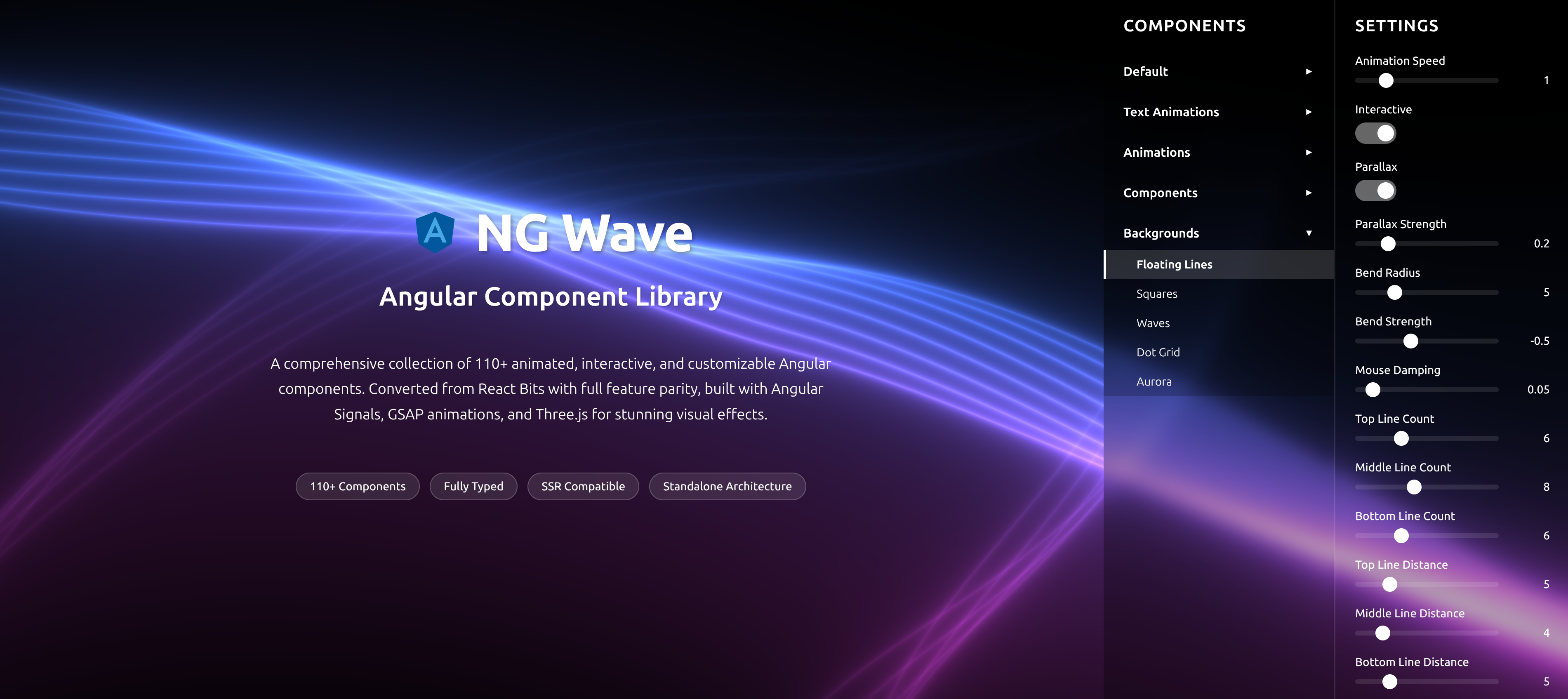
NG Wave
Angular Component Library
A comprehensive collection of 110+ animated, interactive, and customizable Angular components. Converted from React Bits with full feature parity, built with Angular Signals, GSAP animations, and Three.js for stunning visual effects.
Explore Components